


《计算机应用》唯一官方网站 ›› 2026, Vol. 46 ›› Issue (3): 980-992.DOI: 10.11772/j.issn.1001-9081.2025020184
陈敏1,2,3, 秦小林1,2( ), 李绍涵3, 杨昊3, 李韬弘3
收稿日期:2025-03-03
修回日期:2025-04-18
接受日期:2025-04-28
发布日期:2026-03-16
出版日期:2026-03-10
通讯作者:
秦小林
作者简介:陈敏(1989—),女,四川乐山人,博士研究生,主要研究方向:时空预测、数据挖掘、智慧气象基金资助:
Min CHEN1,2,3, Xiaolin QIN1,2(), Shaohan LI3, Hao YANG3, Taohong LI3
Received:2025-03-03
Revised:2025-04-18
Accepted:2025-04-28
Online:2026-03-16
Published:2026-03-10
Contact:
Xiaolin QIN
About author:CHEN Min, born in 1989, Ph. D. candidate. Her research interests include spatio-temporal prediction, data mining, smart meteorology.Supported by:摘要:
深度学习技术的突破性进展为“AI+气象”交叉学科的研究开辟了新的范式,而强对流天气预测因为它的复杂动力学特征和重大社会经济影响成为前沿研究热点。因此,本文系统梳理深度神经网络(DNN)在强对流天气预测领域的理论进展和方法创新,并深入探讨它们的具体应用。首先,基于时空序列预测范式剖析循环神经网络(RNN)与非RNN在气象时序建模中的高频特征捕获机理;其次,从生成式建模的视角,论证生成对抗网络(GAN)和扩散模型在极端天气事件概率预测中的建模优势;再次,揭示气象大模型通过预训练-微调范式实现多模态数据融合与跨尺度特征学习的理论突破,并阐释它们在全球数值天气预报中的泛化能力提升机制;继次,针对模型评估体系,分析传统统计指标在极端天气预测中的局限性,并探讨物理一致性约束等新型评估框架的构建路径;最后,凝练出当前面临的关键科学挑战及未来研究方向,旨在为构建新一代强对流天气预测智能系统提供理论支撑与方法论参考。
中图分类号:
陈敏, 秦小林, 李绍涵, 杨昊, 李韬弘. 深度学习应用于强对流天气预测的综述[J]. 计算机应用, 2026, 46(3): 980-992.
Min CHEN, Xiaolin QIN, Shaohan LI, Hao YANG, Taohong LI. Review of deep learning applications in severe convective weather prediction[J]. Journal of Computer Applications, 2026, 46(3): 980-992.
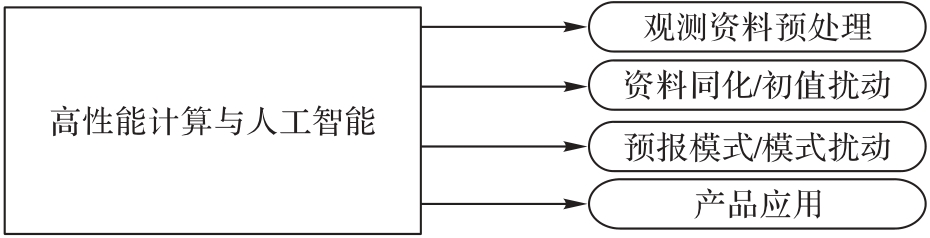
图1 高性能计算与人工智能在气象预报领域的应用
Fig. 1 Application of high-performance computing and AI in weather prediction field
| 类别 | 指标 |
|---|---|
| 全局精度 | MAE, MSE,RMSE, PCC |
| 二值精度 | CSI, Accuracy, FSS, F1-score, POD, Precision, HSS, Recall,FAR |
| 降尺度精度 | CSI-neighborhood, FSS, Pooled CRPS |
| 清晰度精度 | GDL, LPIPS, PSNR, SSIM |
表1 天气预测中常用的评估指标
Tab. 1 Commonly used evaluation metrics in weather prediction
| 类别 | 指标 |
|---|---|
| 全局精度 | MAE, MSE,RMSE, PCC |
| 二值精度 | CSI, Accuracy, FSS, F1-score, POD, Precision, HSS, Recall,FAR |
| 降尺度精度 | CSI-neighborhood, FSS, Pooled CRPS |
| 清晰度精度 | GDL, LPIPS, PSNR, SSIM |
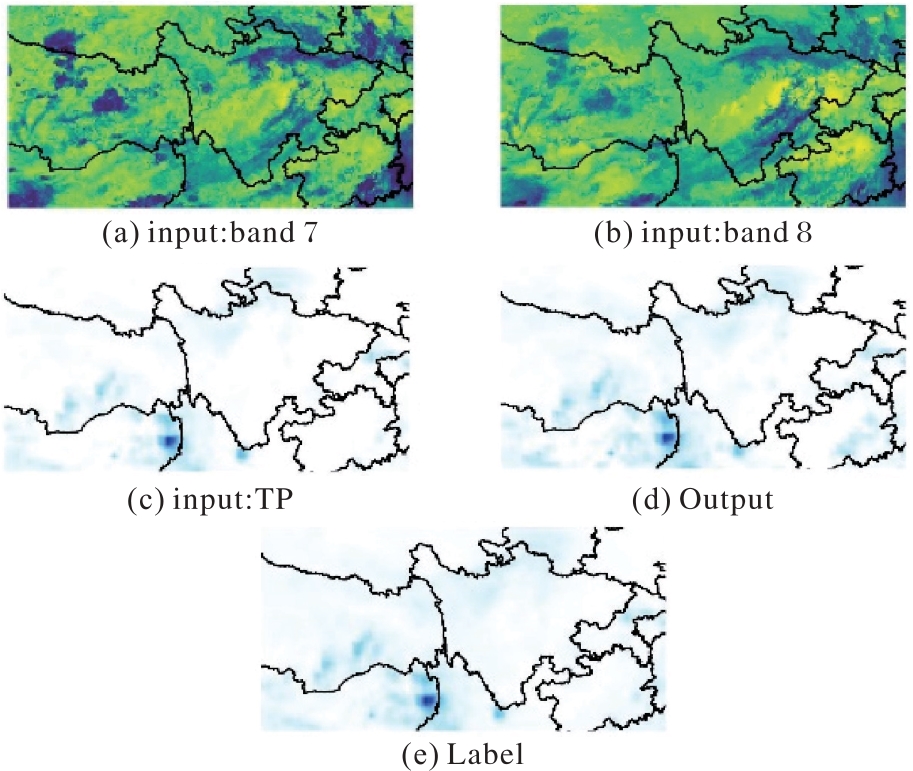
图2 强对流天气预测任务中的降水预测案例
Fig. 2 Case of precipitation prediction in severe convective weather prediction tasks
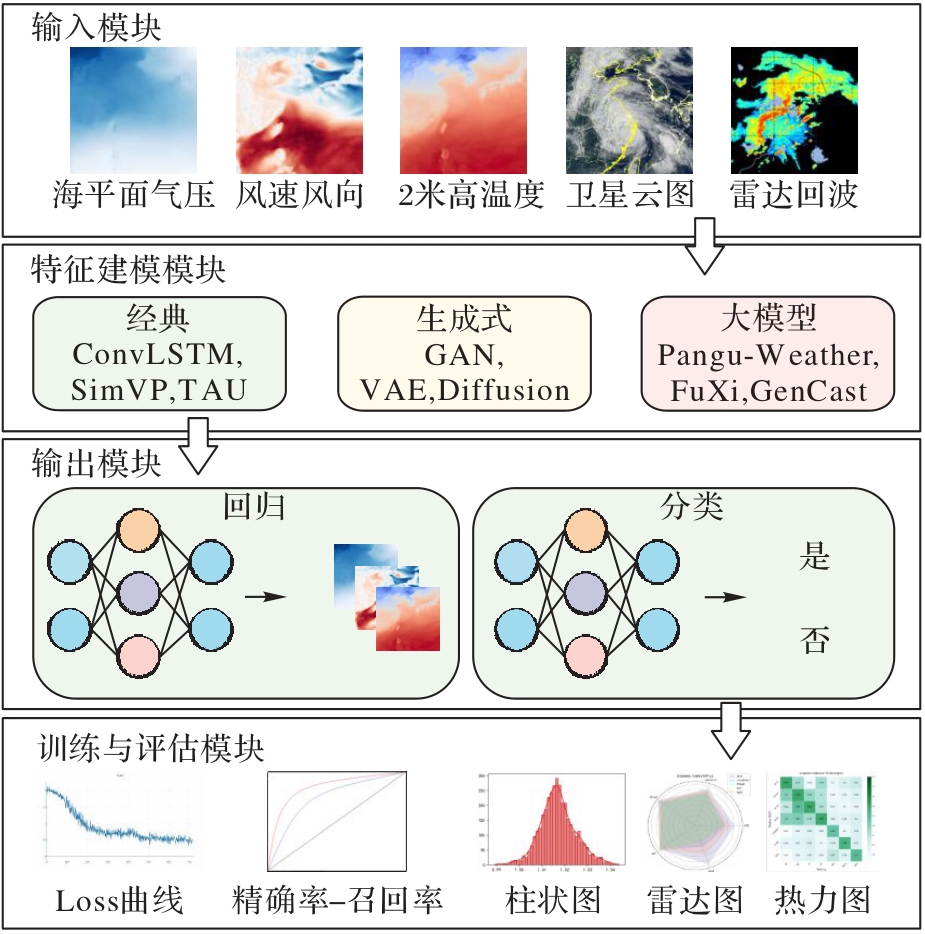
图3 基于深度学习的强对流预测框架
Fig. 3 Deep learning-based framework for severe convective weather prediction
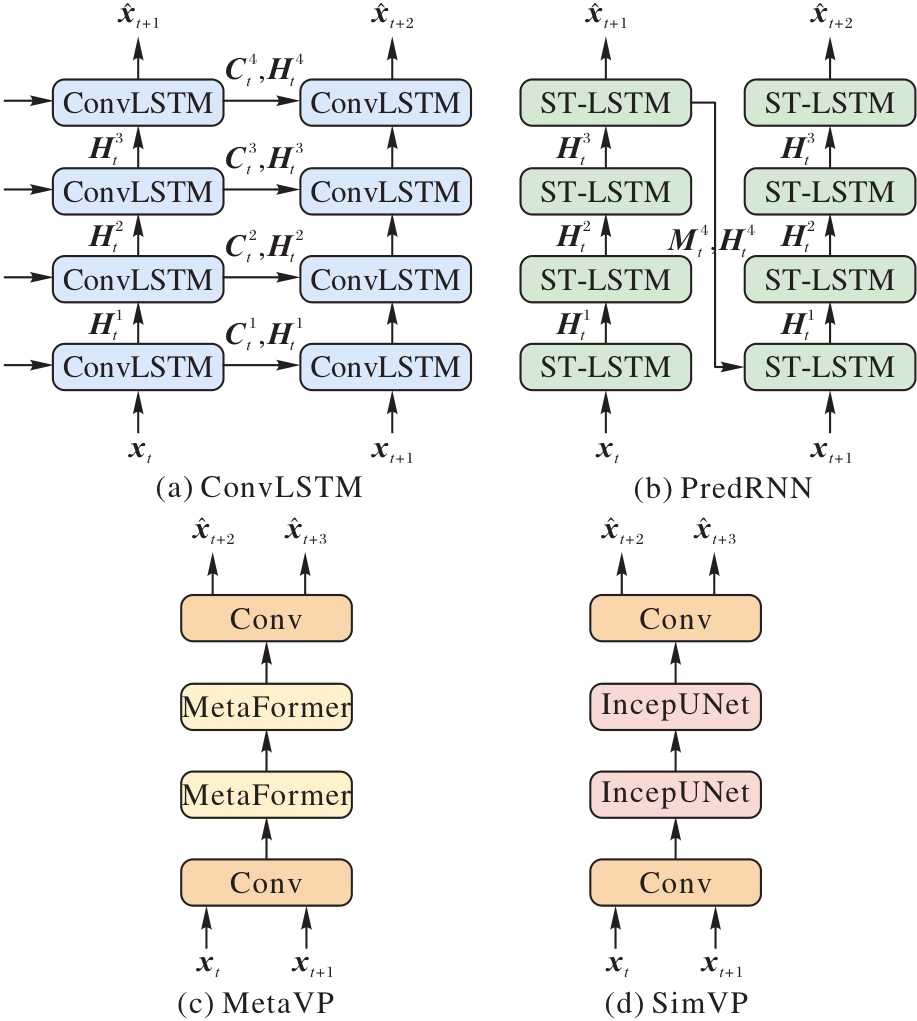
图4 经典的强对流天气预测深度学习方法
Fig. 4 Classical deep learning methods for predicting severe convective weather
| 方法类别 | 代表模型 | 优势 | 劣势 |
|---|---|---|---|
循环 方法 | ConvLSTM | 结合CNN和LSTM结构,捕捉空间和时间依赖关系,适用于短时天气预测。ConvLSTM在气象数据集(如 Radar Echo、ERA5、GFS、ClimateNet)上能有效捕捉降水、温度、风场等时空依赖关系,适用于短期天气预测 | 计算成本高,对长期趋势(如ERA5的长期气候模式)捕捉较弱,易受累积误差影响,在GFS这样的数值天气预报数据上可能不及传统物理模型精确 |
| MotionRNN | 采用时间-空间变换机制,提升对运动信息的建模能力,适用于复杂天气场景 | 计算复杂度较高,对长时间序列预测仍有误差累积问题 | |
| SwinLSTM | 结合Swin Transformer进行局部和全局信息交互,提高时序预测精度 | 结构复杂,对计算资源需求较高,训练难度比较大 | |
非循环 方法 | SimVP | 采用ETD架构,实现端到端多步预测,计算效率高 | 主要依赖CNN,难以捕捉长时间依赖关系 |
| MIMO-VP | 采用Transformer实现MIMO,提高长时序预测能力 | 计算量大,训练难度较大 | |
| TAU | 通过静态注意力和动态注意力优化特征提取,提升计算效率 | 对数据量依赖较高,对不同天气类型的适应性有待提升 | |
生成 模型 | MoCoGAN | 采用运动-内容解耦,增强降水等天气场景的时空一致性 | 生成结果受随机性影响,存在模式崩溃风险 |
| PreDiff | 结合扩散模型进行天气预测,生成效果稳定,适用于不确定性建模 | 计算量大,训练和推理开销较高 | |
| DiffCast | 结合全局UNet,增强降水预测的细节保留能力 | 对高分辨率天气场景的泛化能力有待提升 | |
| 大模型 | GraphCast | 采用GNN进行全球天气预测,具备良好的泛化能力 | 对超长时间尺度的预测仍存一定误差 |
| FourCastNet | 结合Transformer提高天气预测效率,计算速度快 | 需要高质量数据支持,缺乏物理约束 | |
| Pangu-Weather | 端到端建模全球天气,精度超过部分NWP方法 | 训练数据和计算资源需求极大 |
表2 各代表性方法的天气预测模型的优缺点对比
Tab. 2 Comparison of advantages and disadvantages of weather prediction models of various representative method
| 方法类别 | 代表模型 | 优势 | 劣势 |
|---|---|---|---|
循环 方法 | ConvLSTM | 结合CNN和LSTM结构,捕捉空间和时间依赖关系,适用于短时天气预测。ConvLSTM在气象数据集(如 Radar Echo、ERA5、GFS、ClimateNet)上能有效捕捉降水、温度、风场等时空依赖关系,适用于短期天气预测 | 计算成本高,对长期趋势(如ERA5的长期气候模式)捕捉较弱,易受累积误差影响,在GFS这样的数值天气预报数据上可能不及传统物理模型精确 |
| MotionRNN | 采用时间-空间变换机制,提升对运动信息的建模能力,适用于复杂天气场景 | 计算复杂度较高,对长时间序列预测仍有误差累积问题 | |
| SwinLSTM | 结合Swin Transformer进行局部和全局信息交互,提高时序预测精度 | 结构复杂,对计算资源需求较高,训练难度比较大 | |
非循环 方法 | SimVP | 采用ETD架构,实现端到端多步预测,计算效率高 | 主要依赖CNN,难以捕捉长时间依赖关系 |
| MIMO-VP | 采用Transformer实现MIMO,提高长时序预测能力 | 计算量大,训练难度较大 | |
| TAU | 通过静态注意力和动态注意力优化特征提取,提升计算效率 | 对数据量依赖较高,对不同天气类型的适应性有待提升 | |
生成 模型 | MoCoGAN | 采用运动-内容解耦,增强降水等天气场景的时空一致性 | 生成结果受随机性影响,存在模式崩溃风险 |
| PreDiff | 结合扩散模型进行天气预测,生成效果稳定,适用于不确定性建模 | 计算量大,训练和推理开销较高 | |
| DiffCast | 结合全局UNet,增强降水预测的细节保留能力 | 对高分辨率天气场景的泛化能力有待提升 | |
| 大模型 | GraphCast | 采用GNN进行全球天气预测,具备良好的泛化能力 | 对超长时间尺度的预测仍存一定误差 |
| FourCastNet | 结合Transformer提高天气预测效率,计算速度快 | 需要高质量数据支持,缺乏物理约束 | |
| Pangu-Weather | 端到端建模全球天气,精度超过部分NWP方法 | 训练数据和计算资源需求极大 |
| 模型 | MSE | MAE | RMSE |
|---|---|---|---|
| ConvLSTM | 1.521 4 | 0.794 9 | 1.233 5 |
| PredRNN | 1.331 1 | 0.724 6 | 1.153 7 |
| MAU | 1.251 4 | 0.703 6 | 1.118 7 |
| Swin Transformer | 1.142 9 | 0.673 5 | 1.069 1 |
| HorNet | 1.201 4 | 0.690 6 | 1.096 1 |
| TAU | 1.161 9 | 0.670 7 | 1.077 9 |
表3 WeatherBench数据集上不同模型的2 m高度处空气温度(t2m)预测评估指标
Tab. 3 Evaluation metrics of different models for 2-meter air temperature prediction (t2m) on WeatherBench dataset
| 模型 | MSE | MAE | RMSE |
|---|---|---|---|
| ConvLSTM | 1.521 4 | 0.794 9 | 1.233 5 |
| PredRNN | 1.331 1 | 0.724 6 | 1.153 7 |
| MAU | 1.251 4 | 0.703 6 | 1.118 7 |
| Swin Transformer | 1.142 9 | 0.673 5 | 1.069 1 |
| HorNet | 1.201 4 | 0.690 6 | 1.096 1 |
| TAU | 1.161 9 | 0.670 7 | 1.077 9 |
| 模型 | MSE | MAE | RMSE |
|---|---|---|---|
| ConvLSTM | 1.897 6 | 0.921 5 | 1.377 5 |
| PredRNN | 1.881 0 | 0.906 8 | 1.371 5 |
| MAU | 1.900 1 | 0.919 4 | 1.378 4 |
| Swin Transformer | 1.499 6 | 0.814 5 | 1.224 6 |
| HorNet | 1.553 9 | 0.825 4 | 1.246 6 |
| TAU | 1.592 5 | 0.842 6 | 1.261 9 |
表4 WeatherBench数据集上不同模型的10 m高度的水平风矢量(uv10)预测评估指标
Tab. 4 Evaluation metrics of different models for 10-meter wind components prediction (uv10) on WeatherBench dataset
| 模型 | MSE | MAE | RMSE |
|---|---|---|---|
| ConvLSTM | 1.897 6 | 0.921 5 | 1.377 5 |
| PredRNN | 1.881 0 | 0.906 8 | 1.371 5 |
| MAU | 1.900 1 | 0.919 4 | 1.378 4 |
| Swin Transformer | 1.499 6 | 0.814 5 | 1.224 6 |
| HorNet | 1.553 9 | 0.825 4 | 1.246 6 |
| TAU | 1.592 5 | 0.842 6 | 1.261 9 |
| 模型 | MSE | MAE | RMSE |
|---|---|---|---|
| ConvLSTM | 0.049 4 | 0.154 2 | 0.222 3 |
| PredRNN | 0.055 0 | 0.158 8 | 0.234 6 |
| MAU | 0.049 5 | 0.151 6 | 0.222 6 |
| Swin Transformer | 0.046 4 | 0.147 3 | 0.215 4 |
| HorNet | 0.046 9 | 0.147 5 | 0.216 6 |
| TAU | 0.047 2 | 0.146 0 | 0.217 3 |
表5 WeatherBench数据集上不同模型的总云量(tcc)预测评估指标
Tab. 5 Evaluation metrics of different models for total cloud cover (tcc) prediction on WeatherBench dataset
| 模型 | MSE | MAE | RMSE |
|---|---|---|---|
| ConvLSTM | 0.049 4 | 0.154 2 | 0.222 3 |
| PredRNN | 0.055 0 | 0.158 8 | 0.234 6 |
| MAU | 0.049 5 | 0.151 6 | 0.222 6 |
| Swin Transformer | 0.046 4 | 0.147 3 | 0.215 4 |
| HorNet | 0.046 9 | 0.147 5 | 0.216 6 |
| TAU | 0.047 2 | 0.146 0 | 0.217 3 |
| [1] | World Meteorological Organization. State of the global climate 2024[M]. Geneva: World Meteorological Organization, 2025: 23-45. |
| [2] | Intergovernmental Panel on Climate Change. Climate change 2023: the physical science basis [M]. Cambridge: Cambridge University Press, 2023. |
| [3] | 中国气象局. 中国气象年鉴2022[M]. 北京:气象出版社, 2022: 95-98. |
| China Meteorological Administration. China meteorological yearbook 2022 [M]. Beijing: China Meteorological Press, 2022: 95-98. | |
| [4] | PALMER T. A vision for numerical weather prediction in 2030 [EB/OL]. [2024-11-12].. |
| [5] | RIHAN F A, COLLIER C G, ROULSTONE I. Four-dimensional variational data assimilation for Doppler radar wind data [J]. Journal of Computational and Applied Mathematics, 2005, 176(1): 15-34. |
| [6] | YAN Q, JI F, MIAO K, et al. Convolutional residual-attention: a deep learning approach for precipitation nowcasting [J]. Advances in Meteorology, 2020, 2020: No.6484812. |
| [7] | 曾明剑, 王桂臣, 吴海英, 等. 基于中尺度数值模式的分类强对流天气预报方法研究[J]. 气象学报, 2015, 73(5): 868-882. |
| ZENG M J, WANG G C, WU H Y, et al. Study of the forecasting method for the classified severe convection weather based on a meso-scale numerical model [J]. Acta Meteorologica Sinica, 2015, 73(5): 868-882. | |
| [8] | RONNEBERGER O, FISCHER P, BROX T. U-net: convolutional networks for biomedical image segmentation [C]// Proceedings of the 2015 International Conference on Medical Image Computing and Computer-assisted Intervention, LNCS 9351. Cham: Springer, 2015: 234-241. |
| [9] | SHI X, CHEN Z, WANG H, et al. Convolutional LSTM network: a machine learning approach for precipitation nowcasting [C]// Proceedings of the 29th International Conference on Neural Information Processing Systems. Cambridge: MIT Press, 2015: 802-810. |
| [10] | LAM R, SANCHEZ-GONZALEZ A, WILLSON M, et al. Learning skillful medium-range global weather forecasting [J]. Science, 2023, 382(6677): 1416-1421. |
| [11] | 中国气象局. 中国气象局印发《人工智能气象应用工作方案(2023—2030年)》[EB/OL]. [2024-11-12].. |
| China Meteorological Administration. China meteorological administration issues the Artificial Intelligence Meteorological Application Work Plan (2023—2030) [EB/OL]. [2024-11-12].. | |
| [12] | AGAPIOU A. Remote sensing heritage in a petabyte-scale: satellite data and heritage Earth Engine© applications [J]. International Journal of Digital Earth, 2017, 10(1): 85-102. |
| [13] | 高雨佳,王鹏飞,刘亮,等. 基于注意力增强元学习网络的个性化联邦学习方法[J]. 计算机研究与发展, 2024, 61(1): 196-208. |
| GAO Y J, WANG P F, LIU L, et al. Personalized federated learning method based on attention-enhanced meta-learning network [J]. Journal of Computer Research and Development, 2024, 61(1): 196-208. | |
| [14] | 焦鹏飞,陈舒欣,郭翾,等. 图神经常微分方程综述[J]. 计算机研究与发展, 2024, 61(8): 2045-2066. |
| JIAO P F, CHEN S X, GUO X, et al. Survey on graph neural ordinary differential equations [J]. Journal of Computer Research and Development, 2024, 61(8): 2045-2066. | |
| [15] | CHEN T, GUESTRIN C. XGBoost: a scalable tree boosting system [C]// Proceedings of the 22nd ACM SIGKDD International Conference on Knowledge Discovery and Data Mining. New York: ACM, 2016: 785-794. |
| [16] | LEGLER S, JANJIĆ T. Combining data assimilation and machine learning to estimate parameters of a convective-scale model [J]. Journal of Advances in Modeling Earth Systems, 2021, 13(12): e2021MS002534. |
| [17] | NERINI D, FORESTI L, LEUENBERGER D, et al. A reduced-space ensemble Kalman filter approach for flow-dependent integration of radar extrapolation nowcasts and NWP precipitation ensembles [J]. Monthly Weather Review, 2019, 147(3): 987-1006. |
| [18] | DOSWELL C A, Ⅲ, BROOKS H E, MADDOX R A, et al. Flash flood forecasting: an ingredients-based methodology [J]. Weather and Forecasting, 1996, 11(4): 560-581. |
| [19] | PRUDDEN R, ADAMS S, KANGIN D, et al. A review of radar-based nowcasting of precipitation and applicable machine learning[EB/OL]. [2024-03-02].. |
| [20] | BROWNING K A. Review lecture: local weather forecasting [J]. Proceedings of the Royal Society of London. Series A, Mathematical and Physical Sciences, 1980, 371(1745): 179-211. |
| [21] | 田济扬. 天气雷达多源数据同化支持下的陆气耦合水文预报[D]. 北京:中国水利水电科学研究院, 2017. |
| TIAN J Y. Coupled atmospheric-hydrological modeling for hydrological forecast based on multi-source data assimilation containing radar data [D]. Beijing: China Institute of Water Resources and Hydropower Research, 2017. | |
| [22] | 曹伟华,陈明轩,高峰,等. 雷暴区域追踪矢量与雷暴单体追踪矢量融合临近预报研究[J]. 气象学报, 2019, 77(6): 1015-1027. |
| CAO W H, CHEN M X, GAO F, et al. A vector blending study based on object-based tracking vectors and cross correlation tracking vectors [J]. Acta Meteorologica Sinica, 2019, 77(6): 1015-1027. | |
| [23] | CHEN L, DAI J, TAO L. A modified cross-correlation method (COTREC) and its application in precipitation nowcasting [J]. Journal of Tropical Meteorology, 2009, 25(1): 117-122. |
| [24] | 张亚萍,程明虎,夏文梅,等. 天气雷达回波运动场估测及在降水临近预报中的应用[J]. 气象学报, 2006, 64(5): 631-646. |
| ZHANG Y P, CHEN M H, XIA W M, et al. Estimation of weather radar echo motion field and its application to precipitation nowcasting [J]. Acta Meteorological Sinica, 2006, 64(5): 631-646. | |
| [25] | MUELLER C, SAXEN T, ROBERTS R, et al. NCAR auto-nowcast system [J]. Weather and Forecasting, 2003, 18(4): 545-561. |
| [26] | 曹春燕,陈元昭,刘东华,等. 光流法及其在临近预报中的应用[J]. 气象学报, 2015, 73(3): 471-480. |
| CAO C Y, CHEN Y Z, LIU D H, et al. The optical flow method and its application to nowcasting [J]. Acta Meteorologica Sinica, 2015, 73(3): 471-480. | |
| [27] | XU H, ZHANG J, CAI J, et al. GMFlow: learning optical flow via global matching [C]// Proceedings of the 2022 IEEE/CVF Conference on Computer Vision and Pattern Recognition. Piscataway: IEEE, 2022: 8111-8120. |
| [28] | MOHAMMED A D, MORRIS T. Optical flow estimation using local features [EB/OL]. [2024-03-02]. . |
| [29] | HAMDAN A, IBEKWE K I, ETUKUDOH E A, et al. AI and machine learning in climate change research: a review of predictive models and environmental impact [J]. World Journal of Advanced Research and Reviews, 2024, 21(1): 1999-2008. |
| [30] | 胡家晖,卢楚翰,姜有山,等. 深度学习模型TAGAN在强对流回波临近预报中的应用[J]. 大气科学, 2022, 46(4): 805-818. |
| HU J H, LU C H, JIANG Y S, et al. Application of deep learning model TAGAN in nowcasting of strong convective echo[J]. Chinese Journal of Atmospheric Sciences, 2022, 46(4): 805-818. | |
| [31] | SIT M, SEO B C, DEMIR I. IowaRain: a statewide rain event dataset based on weather radars and quantitative precipitation estimation [EB/OL]. [2024-03-02].. |
| [32] | AYZEL G, SCHEFFER T, HEISTERMANN M. RainNet v1.0: a convolutional neural network for radar-based precipitation nowcasting [J]. Geoscientific Model Development, 2020, 13: 2631-2644. |
| [33] | NOAA National Centers for Environmental Prediction. Multi-Radar/Multi-Sensor (MRMS) precipitation data [DS/OL]. [2024-01-15]. . |
| [34] | VEILLETTE M S, SAMSI S, MATTIOLI C J. SEVIR: a storm event imagery dataset for deep learning applications in radar and satellite meteorology [C]// Proceedings of the 34th International Conference on Neural Information Processing Systems. Red Hook: Curran Associates Inc., 2020: 22009-22019. |
| [35] | HERRUZO P, GRUCA A, LLISO L, et al. High-resolution multi-channel weather forecasting: first insights on transfer learning from the Weather4Cast Competitions 2021 [C]// Proceedings of the 2021 IEEE International Conference on Big Data. Piscataway: IEEE, 2021: 5750-5757. |
| [36] | Météo-France. MeteoNet: the open weather dataset [DS/OL]. [2024-01-15].. |
| [37] | European Centre for Medium-range Weather Forecasts (ECMWF). ERA5 fifth generation reanalysis data [DS/OL]. [2024-01-17].. |
| [38] | 中国气象局国家气象信息中心. CMA全球大气再分析数据集(CMA-RA V1.5)[DS/OL]. [2024-01-22].. |
| China Meteorological Administration, National Meteorological Information Center. CMA-RA V1.5 global atmospheric reanalysis dataset [DS/OL]. [2024-01-22].. | |
| [39] | HINTON G E, SALAKHUTDINOV R R. Reducing the dimensionality of data with neural networks [J]. Science, 2006, 313(5786): 504-507. |
| [40] | 尹文君,张大伟,严京海,等. 基于深度学习的大数据空气污染预报[J]. 中国环境管理, 2015, 7(6): 46-52. |
| YIN W J, ZHANG D W, YAN J H, et al. Deep learning based air pollutant forecasting with big data [J]. Chinese Journal of Environmental Management, 2015, 7(6): 46-52. | |
| [41] | SHI J, SHIRALI A, JIN B, et al. Deep learning and foundation models for weather prediction: a survey [EB/OL]. [2025-03-01].. |
| [42] | WANG Y, LONG M, WANG J, et al. PredRNN: recurrent neural networks for predictive learning using spatiotemporal LSTMs [C]// Proceedings of the 31st International Conference on Neural Information Processing Systems. Red Hook: Curran Associates Inc., 2017: 879-888. |
| [43] | WANG Y, JIANG L, YANG M H, et al. Eidetic 3D LSTM: a model for video prediction and beyond [EB/OL]. [2024-11-17].. |
| [44] | WANG Y, ZHANG J, ZHU H, et al. Memory in memory: a predictive neural network for learning higher-order non-stationarity from spatiotemporal dynamics [C]// Proceedings of the 2019 IEEE/CVF Conference on Computer Vision and Pattern Recognition. Piscataway: IEEE, 2019: 9146-9154. |
| [45] | LE GUEN V, THOME N. Disentangling physical dynamics from unknown factors for unsupervised video prediction [C]// Proceedings of the 2020 IEEE/CVF Conference on Computer Vision and Pattern Recognition. Piscataway: IEEE, 2020: 11471-11481. |
| [46] | WU H, YAO Z, WANG J, et al. MotionRNN: a flexible model for video prediction with spacetime-varying motions [C]// Proceedings of the 2021 IEEE/CVF Conference on Computer Vision and Pattern Recognition. Piscataway: IEEE, 2021: 15430-15439. |
| [47] | BAI L, YAO L, LI C, et al. Adaptive graph convolutional recurrent network for traffic forecasting [C]// Proceedings of the 34th International Conference on Neural Information Processing Systems. Red Hook: Curran Associates Inc., 2020: 17804-17815. |
| [48] | LIN H, GAO Z, XU Y, et al. Conditional local convolution for spatio-temporal meteorological forecasting [C]// Proceedings of the 36th AAAI Conference on Artificial Intelligence. Palo Alto: AAAI Press, 2022: 7470-7478. |
| [49] | VASWANI A, SHAZEER N, PARMAR N, et al. Attention is all you need [C]// Proceedings of the 31st International Conference on Neural Information Processing Systems. Red Hook: Curran Associates Inc., 2017: 6000-6010. |
| [50] | LIN Z, LI M, ZHENG Z, et al. Self-attention ConvLSTM for spatiotemporal prediction [C]// Proceedings of the 34th AAAI Conference on Artificial Intelligence. Palo Alto: AAAI Press, 2020: 11531-11538. |
| [51] | TANG S, LI C, ZHANG P, et al. SwinLSTM: improving spatiotemporal prediction accuracy using Swin Transformer and LSTM [C]// Proceedings of the 2023 IEEE/CVF International Conference on Computer Vision. Piscataway: IEEE, 2023: 13424-13433. |
| [52] | CHANG Z, ZHANG X, WANG S, et al. MAU: a motion-aware unit for video prediction and beyond [C]// Proceedings of the 35th International Conference on Neural Information Processing Systems. Red Hook: Curran Associates Inc., 2021: 26950-26962. |
| [53] | TANG Y, DONG P, TANG Z, et al. VMRNN: integrating Vision Mamba and LSTM for efficient and accurate spatiotemporal forecasting [C]// Proceedings of the 2024 IEEE/CVF Conference on Computer Vision and Pattern Recognition Workshops. Piscataway: IEEE, 2024: 5663-5673. |
| [54] | GAO Z, TAN C, WU L, et al. SimVP: simple yet better video prediction [C]// Proceedings of the 2022 IEEE/CVF Conference on Computer Vision and Pattern Recognition. Piscataway: IEEE, 2022: 3160-3170. |
| [55] | CASTRO R, SOUTO Y M, OGASAWARA E, et al. STConvS2S: Spatiotemporal convolutional sequence-to-sequence network for weather forecasting [J]. Neurocomputing, 2021, 426: 285-298. |
| [56] | NING S, LAN M, LI Y, et al. MIMO is all you need: a strong multi-in-multi-out baseline for video prediction [C]// Proceedings of the 37th AAAI Conference on Artificial Intelligence. Palo Alto: AAAI Press, 2023: 1975-1983. |
| [57] | TAN C, LI S, GAO Z, et al. OpenSTL: a comprehensive benchmark of spatio-temporal predictive learning [J]. Advances in Neural Information Processing Systems, 2023: 69819-69831. |
| [58] | DOSOVITSKIY A, BEYER L, KOLESNIKOV A, et al. An image is worth 16x16 words: Transformers for image recognition at scale[EB/OL]. [2024-02-08].. |
| [59] | LIU Z, LIN Y, CAO Y, et al. Swin Transformer: hierarchical Vision Transformer using shifted windows [C]// Proceedings of the 2021 IEEE/CVF International Conference on Computer Vision. Piscataway: IEEE, 2021: 9992-10002. |
| [60] | RAO Y, ZHAO W, TANG Y, et al. HorNet: efficient high-order spatial interactions with recursive gated convolutions [C]// Proceedings of the 36th International Conference on Neural Information Processing Systems. Red Hook: Curran Associates Inc., 2022: 10353-10366. |
| [61] | LI S, WANG Z, LIU Z, et al. MogaNet: multi-order gated aggregation network [EB/OL]. [2024-11-17].. |
| [62] | TAN C, GAO Z, WU L, et al. Temporal attention unit: towards efficient spatiotemporal predictive learning [C]// Proceedings of the 2023 IEEE/CVF Conference on Computer Vision and Pattern Recognition. Piscataway: IEEE, 2023: 18770-18782. |
| [63] | CHEN M, YANG H, LI S, et al. STAA: spatiotemporal alignment attention for short-term precipitation forecasting [J]. IEEE Geoscience and Remote Sensing Letters, 2024, 21: No.1003105. |
| [64] | WU H, XU F, CHEN C, et al. PastNet: introducing physical inductive biases for spatio-temporal video prediction [C]// Proceedings of the 32nd ACM International Conference on Multimedia. New York: ACM, 2024: 2917-2926. |
| [65] | NIE X, YAN Y, LI S, et al. Wavelet-driven spatiotemporal predictive learning: bridging frequency and time variations [C]// Proceedings of the 38th AAAI Conference on Artificial Intelligence. Palo Alto: AAAI Press, 2024: 4334-4342. |
| [66] | TULYAKOV S, LIU M Y, YANG X, et al. MoCoGAN: decomposing motion and content for video generation [C]// Proceedings of the 2018 IEEE Conference on Computer Vision and Pattern Recognition. Piscataway: IEEE, 2018: 1526-1535. |
| [67] | ZHANG C, YANG X, TANG Y, et al. Learning to generate radar image sequences using two-stage generative adversarial networks[J]. IEEE Geoscience and Remote Sensing Letters, 2020, 17(3): 401-405. |
| [68] | LUO C, LI X, YE Y, et al. Experimental study on generative adversarial network for precipitation nowcasting [J]. IEEE Transactions on Geoscience & Remote Sensing, 2022, 60(1): 1-20. |
| [69] | CHANG Z, ZHANG X, WANG S, et al. STRPM: a spatiotemporal residual predictive model for high-resolution video prediction [C]// Proceedings of the 2022 IEEE/CVF Conference on Computer Vision and Pattern Recognition. Piscataway: IEEE, 2022: 13926-13935. |
| [70] | YIN J, MEO C, ROY A, et al. Precipitation nowcasting using physics-informed discriminator generative models [C]// Proceedings of the 32nd European Signal Processing Conference. Piscataway: IEEE, 2024: 967-971. |
| [71] | AKAN A K, ERDEM E, ERDEM A, et al. SLAMP: stochastic latent appearance and motion prediction [C]// Proceedings of the 2021 IEEE/CVF International Conference on Computer Vision. Piscataway: IEEE, 2021: 14708-14717. |
| [72] | GAO Z, SHI X, HAN B, et al. PreDiff: precipitation nowcasting with latent diffusion models [C]// Proceedings of the 37th International Conference on Neural Information Processing Systems. Red Hook: Curran Associates Inc., 2024: 78621-78656. |
| [73] | YU D, LI X, YE Y, et al. DiffCast: a unified framework via residual diffusion for precipitation nowcasting [C]// Proceedings of the 2024 IEEE/CVF Conference on Computer Vision and Pattern Recognition. Piscataway: IEEE, 2024: 27758-27767. |
| [74] | ZHANG Z, HU J, CHENG W, et al. ExtDM: distribution extrapolation diffusion model for video prediction[C]// Proceedings of the 2024 IEEE/CVF Conference on Computer Vision and Pattern Recognition. Piscataway: IEEE, 2024: 19310-19320. |
| [75] | PATHAK J, SUBRAMANIAN S, HARRINGTON P, et al. FourCastNet: a global data-driven high-resolution weather model using adaptive Fourier neural operators [EB/OL]. [2024-03-11].. |
| [76] | ZHANG Y, LONG M, CHEN K, et al. Skilful nowcasting of extreme precipitation with NowcastNet [J]. Nature, 2023, 619(7970): 526-532. |
| [77] | BI K, XIE L, ZHANG H, et al. Accurate medium-range global weather forecasting with 3D neural networks [J]. Nature, 2023, 619(7970): 533-538. |
| [78] | CHEN K, HAN T, GONG J, et al. FengWu: pushing the skillful global medium-range weather forecast beyond 10 days lead [EB/OL]. [2024-03-24].. |
| [79] | ANDRYCHOWICZ M, ESPEHOLT L, LI D, et al. Deep learning for day forecasts from sparse observations [EB/OL]. [2024-11-15].. |
| [80] | CHEN L, ZHONG X, LI H, et al. A machine learning model that outperforms conventional global subseasonal forecast models [J]. Nature Communications, 2024, 15: No.6425. |
| [81] | PRICE I, SANCHEZ-GONZALEZ A, ALET F, et al. GenCast: diffusion-based ensemble forecasting for medium-range weather[EB/OL]. [2024-11-16].. |
| [1] | 张健, 于剑波, 汤健. 基于多层预处理的城市固废焚烧状态识别方法[J]. 《计算机应用》唯一官方网站, 2026, 46(3): 940-949. |
| [2] | 姜勇维, 陈晓清, 付麟杰. 基于频谱分解的高频保持医学图像弹性配准模型[J]. 《计算机应用》唯一官方网站, 2026, 46(3): 924-932. |
| [3] | 余松森, 何皇, 薛国鹏, 崔恒拓. 基于改进FENet的瓷砖色差量化分级方法[J]. 《计算机应用》唯一官方网站, 2026, 46(3): 959-968. |
| [4] | 邵培荣, 蔺素珍, 王彦博. 以人为中心的细节增强虚拟试衣方法[J]. 《计算机应用》唯一官方网站, 2026, 46(3): 915-923. |
| [5] | 胡岩, 李鹏, 成姝燕. 基于直接引导扩散模型的对抗净化方法[J]. 《计算机应用》唯一官方网站, 2026, 46(3): 821-829. |
| [6] | 韩锋, 卜永丰, 梁浩翔, 黄舒雯, 张朝阳, 孙士杰. 基于多层次时空交互依赖的车辆轨迹异常检测[J]. 《计算机应用》唯一官方网站, 2026, 46(2): 604-612. |
| [7] | 陈晓雷, 郑芷薇, 黄雪, 曲振彬. 结合球面对齐与自适应几何校正的全景视频超分辨率网络[J]. 《计算机应用》唯一官方网站, 2026, 46(2): 528-535. |
| [8] | 刘权捷, 顾兆一, 王春源. 复杂光照条件下的不安全驾驶行为检测[J]. 《计算机应用》唯一官方网站, 2026, 46(2): 613-619. |
| [9] | 林金娇, 张灿舜, 陈淑娅, 王天鑫, 连剑, 徐庸辉. 基于改进图注意力网络的车险欺诈检测方法[J]. 《计算机应用》唯一官方网站, 2026, 46(2): 437-444. |
| [10] | 姜皓骞, 张东, 李冠宇, 陈恒. 基于结构增强的层次化任务导向提示策略的对话推荐系统SetaCRS[J]. 《计算机应用》唯一官方网站, 2026, 46(2): 368-377. |
| [11] | 付锦程, 杨仕友. 基于贝叶斯优化和特征融合混合模型的短期风电功率预测[J]. 《计算机应用》唯一官方网站, 2026, 46(2): 652-658. |
| [12] | 李名, 王孟齐, 张爱丽, 任花, 窦育强. 基于条件生成对抗网络和混合注意力机制的图像隐写方法[J]. 《计算机应用》唯一官方网站, 2026, 46(2): 475-484. |
| [13] | 曹杰, 谢凌锋, 王丙金, 张昌河, 余紫东, 邓超. 考虑类不平衡和背景多样性问题的青少年脊柱侧弯筛查方法[J]. 《计算机应用》唯一官方网站, 2026, 46(2): 630-639. |
| [14] | 郭泽一, 李凤莲, 徐利春. 基于双重决策机制的深度符号回归算法[J]. 《计算机应用》唯一官方网站, 2026, 46(2): 406-415. |
| [15] | 崔克俭, 王志明, 邱兆文. 基于光学相干断层扫描血管成像的视网膜血管分割与冠心病预测方法[J]. 《计算机应用》唯一官方网站, 2026, 46(2): 640-651. |
| 阅读次数 | ||||||
|
全文 |
|
|||||
|
摘要 |
|
|||||
