


《计算机应用》唯一官方网站 ›› 2026, Vol. 46 ›› Issue (10): 3365-3374.DOI: 10.11772/j.issn.1001-9081.2025091147
• 前沿与综合应用 • 上一篇
任俊箫1, 蓝小艳1, 史旭阳1,2( ), 李强1
收稿日期:2025-09-26
修回日期:2025-12-01
接受日期:2025-12-03
发布日期:2025-12-18
出版日期:2026-10-10
通讯作者:
史旭阳
作者简介:任俊箫(1991—),男,四川绵阳人,讲师,博士,主要研究方向:信号处理、深度学习基金资助:
Junxiao REN1, Xiaoyan LAN1, Xuyang SHI1,2(), Qiang LI1
Received:2025-09-26
Revised:2025-12-01
Accepted:2025-12-03
Online:2025-12-18
Published:2026-10-10
Contact:
Xuyang SHI
About author:REN Junxiao, born in 1991, Ph. D., lecturer. His research interests include signal processing, deep learning.Supported by:摘要:
有效的抑郁检测对于早期发现抑郁症潜在风险至关重要。传统方法依赖于临床访谈具有较强的主观性,易导致误诊和延误治疗。随着人工智能的发展,深度学习(DL)技术凭借卓越的特征表示与建模能力,逐渐成为抑郁检测的核心方法。然而,现有综述大多仍侧重于单一模态或传统方法,缺乏对抑郁检测领域中多模态深度学习方法的系统归纳,而多模态数据在提供互补抑郁线索上具有显著优势。因此,系统地综述了典型DL模型与多模态融合策略,总结了该领域的核心技术和最新进展。首先,回顾了抑郁检测方法从单模态到多模态的演进过程,形成以数据集与方法为主线的发展脉络。其次,重点讨论了抑郁检测应用中流行的深度学习模型及多模态融合策略,对比了不同模型与融合策略的性能差异,同时评述了不同多模态融合技术的优势和局限性。最后,总结了该领域所面临的挑战与未来创新的潜在方向。
中图分类号:
任俊箫, 蓝小艳, 史旭阳, 李强. 基于深度学习的多模态抑郁检测研究进展与未来展望[J]. 计算机应用, 2026, 46(10): 3365-3374.
Junxiao REN, Xiaoyan LAN, Xuyang SHI, Qiang LI. Research progress and future prospects of multimodal depression detection based on deep learning[J]. Journal of Computer Applications, 2026, 46(10): 3365-3374.
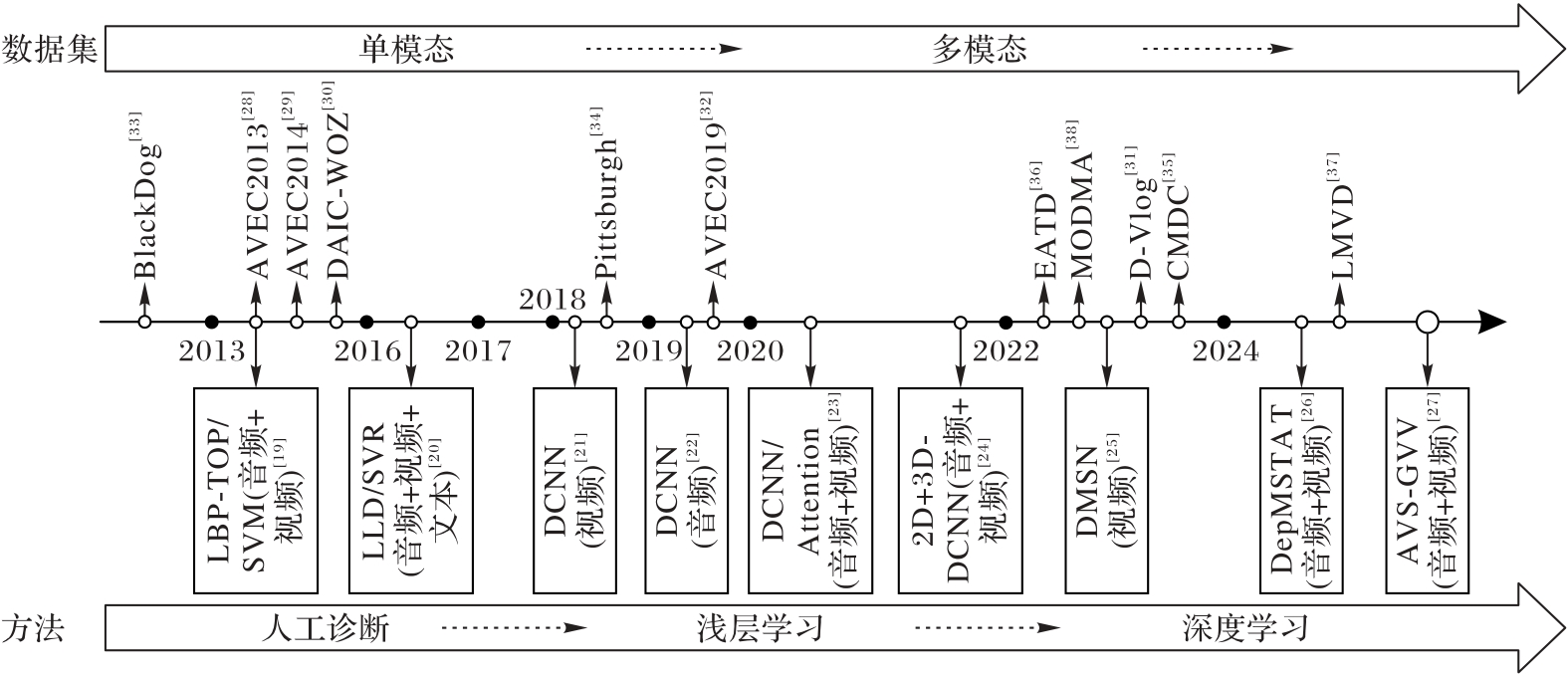
图1 抑郁检测方法与数据集的发展历程
Fig. 1 Development of depression detection methods and datasets
| 数据集 | 数据类型 | 被试者数 | 样本数 | 评估方法 | 评估标准 | 分类/回归 | 是否公开 |
|---|---|---|---|---|---|---|---|
| BlackDog[ | 视频+音频 | 130 | 80 | QIDS-SR | 临床诊断 | 分类 | 未公开 |
| AVEC2013[ | 视频+音频 | 82 | 150 | BDI-Ⅱ | 自我报告 | 回归 | 是(原始视频) |
| AVEC2014[ | 视频+音频 | 84 | 300 | BDI-Ⅱ | 自我报告 | 回归 | 是(原始视频) |
| DAIC-WOZ[ | 视频+音频+文本 | 142 | 189 | PHQ-8 | 自我报告 | 分类 | 是(仅公开特征) |
| AVEC2019[ | 视频+音频+文本 | 219 | 175 | PHQ-8 | 自我报告 | 分类 | 是(仅公开特征) |
| Pittsburgh[ | 视频+音频 | 49 | 57 | DSM/HAMD | 临床诊断 | 分类 | 是(仅公开特征) |
| CMDC[ | 视频+音频+文本 | — | 78 | PHQ-9 | 临床诊断 | 分类 | 是(仅公开特征) |
| EATD[ | 音频+文本 | — | 162 | SDS | 自我报告 | 分类 | 是(原始音频) |
| D-Vlog[ | 视频+音频 | 816 | 961 | 人工标注 | 视频日志 | 分类 | 是(仅公开特征) |
| LMVD[ | 视频+音频 | 1 475 | 1 823 | 人工标注 | 视频日志 | 分类 | 是(仅公开特征) |
| MODMA[ | 音频+脑电 | — | 147 | PHQ-9/DSM-Ⅳ | 临床诊断 | 分类 | 是(原始音频/脑电) |
表1 多模态抑郁检测数据集的总结
Tab. 1 Summary of multimodal depression detection datasets
| 数据集 | 数据类型 | 被试者数 | 样本数 | 评估方法 | 评估标准 | 分类/回归 | 是否公开 |
|---|---|---|---|---|---|---|---|
| BlackDog[ | 视频+音频 | 130 | 80 | QIDS-SR | 临床诊断 | 分类 | 未公开 |
| AVEC2013[ | 视频+音频 | 82 | 150 | BDI-Ⅱ | 自我报告 | 回归 | 是(原始视频) |
| AVEC2014[ | 视频+音频 | 84 | 300 | BDI-Ⅱ | 自我报告 | 回归 | 是(原始视频) |
| DAIC-WOZ[ | 视频+音频+文本 | 142 | 189 | PHQ-8 | 自我报告 | 分类 | 是(仅公开特征) |
| AVEC2019[ | 视频+音频+文本 | 219 | 175 | PHQ-8 | 自我报告 | 分类 | 是(仅公开特征) |
| Pittsburgh[ | 视频+音频 | 49 | 57 | DSM/HAMD | 临床诊断 | 分类 | 是(仅公开特征) |
| CMDC[ | 视频+音频+文本 | — | 78 | PHQ-9 | 临床诊断 | 分类 | 是(仅公开特征) |
| EATD[ | 音频+文本 | — | 162 | SDS | 自我报告 | 分类 | 是(原始音频) |
| D-Vlog[ | 视频+音频 | 816 | 961 | 人工标注 | 视频日志 | 分类 | 是(仅公开特征) |
| LMVD[ | 视频+音频 | 1 475 | 1 823 | 人工标注 | 视频日志 | 分类 | 是(仅公开特征) |
| MODMA[ | 音频+脑电 | — | 147 | PHQ-9/DSM-Ⅳ | 临床诊断 | 分类 | 是(原始音频/脑电) |
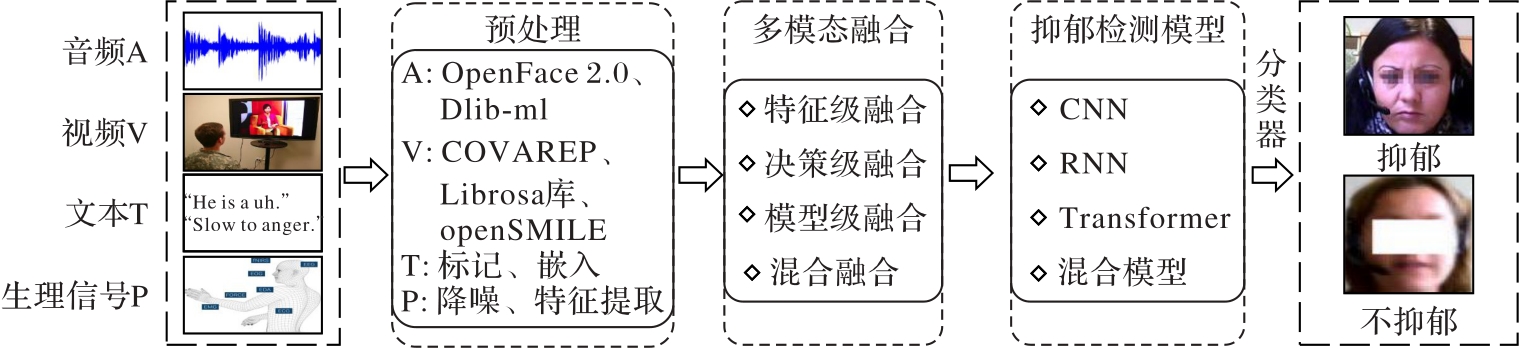
图2 多模态抑郁检测的流程
Fig. 2 Flow of multimodal depression detection
| 数据集 | 模型框架 | 回归/分类任务(分类器) | 性能评估 |
|---|---|---|---|
AVEC2013或 AVEC2014 | DepressNet[ | 回归任务 | MAE: 6.20(AVEC2013),MAE: 6.21(AVEC2014) |
| CNN+RNN[ | 回归任务 | MAE: 7.37(AVEC2013),MAE: 7.22(AVEC2014) | |
| PRA-Net[ | 回归任务 | MAE: 6.08(AVEC2013),MAE: 6.04(AVEC2014) | |
| CNN+Transformer[ | 回归任务 | MAE: 6.05(AVEC2013),MAE: 6.01(AVEC2014) | |
| PointTransform[ | 回归任务 | MAE: 5.33(AVEC2013),MAE: 5.17(AVEC2014) | |
| CCANet(2D CNN)[ | 回归任务 | MAE: 6.66 | |
| LSCAformer[ | 回归任务 | MAE: 6.12(AVEC2013),MAE: 6.05(AVEC2014) | |
| DAIC-WOZ | LSTM[ | 分类任务(FC+Softmax) | Acc: 76.27% |
| CNN+RNN[ | 分类任务(FC) | Acc: 95.81% | |
| CNN+BiLSTM[ | 回归任务 | MAE: 4.92 | |
| RNN[ | 分类任务(FC+Softmax) | Acc: 83% | |
| LSTM[ | 回归任务 | MAE: 3.87 | |
| STFN[ | 回归任务 | MAE: 5.38 | |
| CNN+LSTM[ | 分类任务(FC+Softmax) | Acc: 86.10% | |
| D-Vlog | TAMFN[ | 分类任务(FC+Softmax) | F1: 65.82% |
| DepMSTAT[ | 分类任务(FC+Softmax) | Acc: 71.53% | |
| AVS-GNN[ | 分类任务(对比学习) | F1: 88.17% | |
| 自建数据集 | LSTM[ | 分类任务(FC+Softmax) | Acc: 80.70% |
| CNN-BiLSTM+Attention[ | 分类任务(FC+Softmax) | Acc: 96.71% | |
| SFE-Former[ | 回归任务,分类任务(FC+Softmax) | MAE: 5.53,Acc: 89.3% |
表2 相同数据集上不同模型的性能比较
Tab. 2 Performance comparisons of different models on same datasets
| 数据集 | 模型框架 | 回归/分类任务(分类器) | 性能评估 |
|---|---|---|---|
AVEC2013或 AVEC2014 | DepressNet[ | 回归任务 | MAE: 6.20(AVEC2013),MAE: 6.21(AVEC2014) |
| CNN+RNN[ | 回归任务 | MAE: 7.37(AVEC2013),MAE: 7.22(AVEC2014) | |
| PRA-Net[ | 回归任务 | MAE: 6.08(AVEC2013),MAE: 6.04(AVEC2014) | |
| CNN+Transformer[ | 回归任务 | MAE: 6.05(AVEC2013),MAE: 6.01(AVEC2014) | |
| PointTransform[ | 回归任务 | MAE: 5.33(AVEC2013),MAE: 5.17(AVEC2014) | |
| CCANet(2D CNN)[ | 回归任务 | MAE: 6.66 | |
| LSCAformer[ | 回归任务 | MAE: 6.12(AVEC2013),MAE: 6.05(AVEC2014) | |
| DAIC-WOZ | LSTM[ | 分类任务(FC+Softmax) | Acc: 76.27% |
| CNN+RNN[ | 分类任务(FC) | Acc: 95.81% | |
| CNN+BiLSTM[ | 回归任务 | MAE: 4.92 | |
| RNN[ | 分类任务(FC+Softmax) | Acc: 83% | |
| LSTM[ | 回归任务 | MAE: 3.87 | |
| STFN[ | 回归任务 | MAE: 5.38 | |
| CNN+LSTM[ | 分类任务(FC+Softmax) | Acc: 86.10% | |
| D-Vlog | TAMFN[ | 分类任务(FC+Softmax) | F1: 65.82% |
| DepMSTAT[ | 分类任务(FC+Softmax) | Acc: 71.53% | |
| AVS-GNN[ | 分类任务(对比学习) | F1: 88.17% | |
| 自建数据集 | LSTM[ | 分类任务(FC+Softmax) | Acc: 80.70% |
| CNN-BiLSTM+Attention[ | 分类任务(FC+Softmax) | Acc: 96.71% | |
| SFE-Former[ | 回归任务,分类任务(FC+Softmax) | MAE: 5.53,Acc: 89.3% |
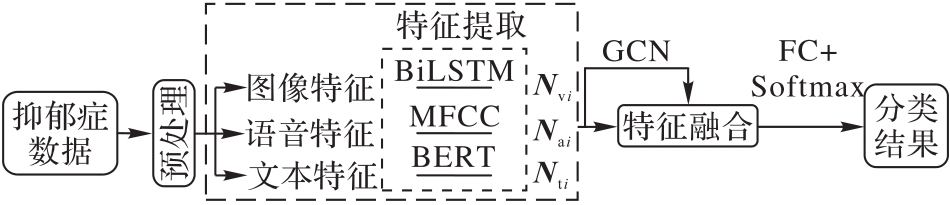
图3 特征级融合的抑郁检测
Fig. 3 Depression detection with feature-level fusion

图4 决策级融合的抑郁检测流程
Fig. 4 Flow of depression detection with decision-level fusion
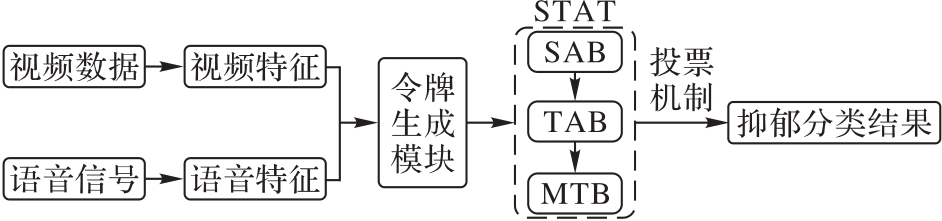
图5 模型级融合的抑郁检测流程
Fig. 5 Flow of depression detection with model-level fusion
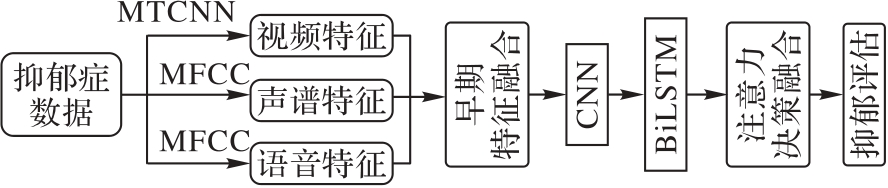
图6 混合融合的抑郁检测
Fig. 6 Depression detection with hybrid fusion
| 融合方法 | 优势 | 局限性 | 应用场景 |
|---|---|---|---|
| 特征级融合 | 能够较早地融合多模态特征,便于联合特征学习, 且实现简单 | 存在高维冗余与模态失衡问题, 无法捕捉不同模态之间的关联性 | 适用于模态特征维度低、 需要早期融合的任务 |
| 决策级融合 | 能够有效地训练和从个体特征中提取特征, 小样本或有限数据情况下具有显著优势 | 未充分考虑模态间的内在联系, 忽略了互补信息 | 适用于标注数据稀缺的应用场景 |
| 模型级融合 | 对每个模态分别建模,考虑模态间的内在联系, 能捕获跨模态交互 | 模型结构复杂,难有效训练和 从单模态中提取特征 | 适用于模态间深层、动态的 信息交换与协同建模的任务 |
| 混合融合策略 | 综合不同融合策略的优点,灵活性强, 适应多任务需求 | 模型设计与调优难度大, 可能有过拟合风险 | 适用于多种异构模数据的 集成任务 |
表3 多模态数据融合方法的优缺点及应用场景的总结
Tab. 3 Summary of advantages, disadvantages, and application scenarios of multimodal data fusion methods
| 融合方法 | 优势 | 局限性 | 应用场景 |
|---|---|---|---|
| 特征级融合 | 能够较早地融合多模态特征,便于联合特征学习, 且实现简单 | 存在高维冗余与模态失衡问题, 无法捕捉不同模态之间的关联性 | 适用于模态特征维度低、 需要早期融合的任务 |
| 决策级融合 | 能够有效地训练和从个体特征中提取特征, 小样本或有限数据情况下具有显著优势 | 未充分考虑模态间的内在联系, 忽略了互补信息 | 适用于标注数据稀缺的应用场景 |
| 模型级融合 | 对每个模态分别建模,考虑模态间的内在联系, 能捕获跨模态交互 | 模型结构复杂,难有效训练和 从单模态中提取特征 | 适用于模态间深层、动态的 信息交换与协同建模的任务 |
| 混合融合策略 | 综合不同融合策略的优点,灵活性强, 适应多任务需求 | 模型设计与调优难度大, 可能有过拟合风险 | 适用于多种异构模数据的 集成任务 |
| 融合方法 | 模态 | 数据集 | 模型框架 | 性能指标 |
|---|---|---|---|---|
| 特征级融合 | 视频+音频 | D-Vlog、EATD | TAMFN[ | F1: 65.82%,F1: 75% |
| 视频+音频+文本 | DAIC-WOZ | RNN[ | Acc: 83% | |
| 视频+音频 | D-Vlog | MDAVIF[ | F1: 75.25% | |
| 视频+音频+文本 | DAIC-WOZ | BiLSTM-GCN[ | F1: 96.30% | |
| 决策级融合 | 音频+文本 | DAIC-WOZ | CNN+Transformer[ | F1: 87% |
| 视频+音频+文本 | DAIC-WOZ | BiLSTM-GNN[ | Acc: 86.10% | |
| 视频+音频 | DAIC-WOZ | CNN+LSTM[ | Acc: 93%(视频),Acc: 83%(音频) | |
| 模型级融合 | 视频+音频 | D-Vlog | DepMSTAT[ | Acc: 71.53%,F1: 73.51% |
| 视频+音频 | DAIC-WOZ | PMBFN[ | MAE: 3.87 | |
| 视频+音频+文本 | DAIC-WOZ | MSGAF[ | F1: 93%,F1: 95% | |
| 视频+音频 | DAIC-WOZ | AVS-GNN[ | F1: 74.61% | |
| 混合融合策略 | 视频+音频 | AVEC2013、AVEC2014 | CNN-BiLSTM[ | MAE: 6.48,MAE: 7.01 |
| 视频+音频+rPPG | AVEC2013、AVEC2014 | TMFE+GFN[ | MAE: 6.60,MAE: 7.05 | |
| 音频+文本 | AVEC2013、AVEC2014 | SIMMA[ | MAE: 5.35,MAE: 5.14 |
表4 抑郁检测中多模态数据的融合方法的总结
Tab. 4 Summary of multimodal data fusion methods in depression detection
| 融合方法 | 模态 | 数据集 | 模型框架 | 性能指标 |
|---|---|---|---|---|
| 特征级融合 | 视频+音频 | D-Vlog、EATD | TAMFN[ | F1: 65.82%,F1: 75% |
| 视频+音频+文本 | DAIC-WOZ | RNN[ | Acc: 83% | |
| 视频+音频 | D-Vlog | MDAVIF[ | F1: 75.25% | |
| 视频+音频+文本 | DAIC-WOZ | BiLSTM-GCN[ | F1: 96.30% | |
| 决策级融合 | 音频+文本 | DAIC-WOZ | CNN+Transformer[ | F1: 87% |
| 视频+音频+文本 | DAIC-WOZ | BiLSTM-GNN[ | Acc: 86.10% | |
| 视频+音频 | DAIC-WOZ | CNN+LSTM[ | Acc: 93%(视频),Acc: 83%(音频) | |
| 模型级融合 | 视频+音频 | D-Vlog | DepMSTAT[ | Acc: 71.53%,F1: 73.51% |
| 视频+音频 | DAIC-WOZ | PMBFN[ | MAE: 3.87 | |
| 视频+音频+文本 | DAIC-WOZ | MSGAF[ | F1: 93%,F1: 95% | |
| 视频+音频 | DAIC-WOZ | AVS-GNN[ | F1: 74.61% | |
| 混合融合策略 | 视频+音频 | AVEC2013、AVEC2014 | CNN-BiLSTM[ | MAE: 6.48,MAE: 7.01 |
| 视频+音频+rPPG | AVEC2013、AVEC2014 | TMFE+GFN[ | MAE: 6.60,MAE: 7.05 | |
| 音频+文本 | AVEC2013、AVEC2014 | SIMMA[ | MAE: 5.35,MAE: 5.14 |
| [1] | Reddy M S. Depression — the global crisis[J]. Indian Journal of Psychological Medicine, 2012, 34(3): 201-203. |
| [2] | 秦璟,秦志光,李发礼,等. 基于概率稀疏自注意力神经网络的重性抑郁疾患诊断[J]. 计算机应用, 2024, 44(9): 2970-2974. |
| Qin Jing, Qin Zhiguang, Li Fali, et al. Diagnosis of major depressive disorder based on probabilistic sparse self-attention neural network[J]. Journal of Computer Applications, 2024, 44(9): 2970-2974. | |
| [3] | Pan J, Lin H, Dong Y, et al. MAMF-GCN: multi-scale adaptive multi-channel fusion deep graph convolutional network for predicting mental disorder[J]. Computers in Biology and Medicine, 2022, 148: No.105823. |
| [4] | Zhao X, Lou Z, Shah P T, et al. Integration of multi-modal biosensing approaches for depression: current status, challenges, and future perspectives[J]. Sensors, 2025, 25(15): No.4858. |
| [5] | Hamilton M. The Hamilton rating scale for depression[M]// Sartorius N, Ban T A. Assessment of depression. Berlin: Springer, 1986: 143-152. |
| [6] | Pampouchidou A, Simos P G, Marias K, et al. Automatic assessment of depression based on visual cues: a systematic review[J]. IEEE Transactions on Affective Computing, 2019, 10(4): 445-470. |
| [7] | Yang S, Liu S, Nie G, et al. Fine-grained multimodal fusion for depression assisted recognition based on hierarchical knowledge-enhanced prompt learning[J]. Expert Systems with Applications, 2025, 291: No.128532. |
| [8] | Lin Z, Wang Y, Zhou Y, et al. STE-Mamba: automated multimodal depression detection through emotional analysis and spatio-temporal information ensemble[C]// ICASSP 2025. Piscataway: IEEE, 2025: 1-5. |
| [9] | Thakur P, Kaur N, Aggarwal N, et al. A comprehensive review of unimodal and multimodal emotion detection: datasets, approaches, and limitations[J]. Expert Systems, 2025, 42(9): No.e70103. |
| [10] | 刘振焘,向春妮,刘陈陵,等. 基于语音的抑郁检测研究综述[J]. 信号处理, 2023, 39(4): 616-631. |
| Liu Zhentao, Xiang Chunni, Liu Chenling, et al. Survey on depression detection research based on speech signals[J]. Journal of Signal Processing, 2023, 39(4): 616-631. | |
| [11] | Han M M, Li X Y, Yi X Y, et al. Automatic recognition of depression based on audio and video: a review[J]. World Journal of Psychiatry, 2024, 14(2): 225-233. |
| [12] | 张石清,张星楠,赵小明. 基于音视频信息的深度多模态抑郁症识别综述[J]. 计算机技术与发展, 2023, 33(7): 1-11, 40. |
| Zhang Shiqing, Zhang Xingnan, Zhao Xiaoming. A survey of deep multimodal depression recognition based on audio-visual cues[J]. Computer Technology and Development, 2023, 33(7): 1-11, 40. | |
| [13] | Cao X, Zhai L, Zhai P, et al. Deep learning-based depression recognition through facial expression: a systematic review[J]. Neurocomputing, 2025, 627: No.129605. |
| [14] | Song S, Luo Y, Tumer T, et al. Loss relaxation strategy for noisy facial video-based automatic depression recognition[J]. ACM Transactions on Computing for Healthcare, 2024, 5(2): No.12. |
| [15] | Xia Y, Liu L, Dong T, et al. A depression detection model based on multimodal graph neural network[J]. Multimedia Tools and Applications, 2024, 83(23): 63379-63395. |
| [16] | Wang R, Huang J, Zhang J, et al. FacialPulse: an efficient RNN-based depression detection via temporal facial landmarks[C]// MM 2024. New York: ACM, 2024: 311-320. |
| [17] | Zhang X, Li B, Qi G. A novel multimodal depression diagnosis approach utilizing a new hybrid fusion method[J]. Biomedical Signal Processing and Control, 2024, 96(Pt A): No.106552. |
| [18] | Li M, Wang Y, Yang C, et al. Automatic diagnosis of depression based on facial expression information and deep convolutional neural network[J]. IEEE Transactions on Computational Social Systems, 2024, 11(5): 5728-5739. |
| [19] | Joshi J, Goecke R, Alghowinem S, et al. Multimodal assistive technologies for depression diagnosis and monitoring[J]. Journal on Multimodal User Interfaces, 2013, 7(3): 217-228. |
| [20] | Yang L, Jiang D, He L, et al. Decision tree based depression classification from audio video and language information[C]// AVEC 2016. New York: ACM, 2016: 89-96. |
| [21] | Zhu Y, Shang Y, Shao Z, et al. Automated depression diagnosis based on deep networks to encode facial appearance and dynamics[J]. IEEE Transactions on Affective Computing, 2018, 9(4): 578-584. |
| [22] | He L, Jiang D, Sahli H. Automatic depression analysis using dynamic facial appearance descriptor and Dirichlet process Fisher encoding[J]. IEEE Transactions on Multimedia, 2019, 21(6): 1476-1486. |
| [23] | Niu M, Tao J, Liu B, et al. Multimodal spatiotemporal representation for automatic depression level detection[J]. IEEE Transactions on Affective Computing, 2023, 14(1): 294-307. |
| [24] | Guo W, Yang H, Liu Z, et al. Deep neural networks for depression recognition based on 2D and 3D facial expressions under emotional stimulus tasks[J]. Frontiers in Neuroscience, 2021, 15: No.609760. |
| [25] | de Melo W C, Granger E, Hadid A. A deep multiscale spatiotemporal network for assessing depression from facial dynamics[J]. IEEE Transactions on Affective Computing, 2022, 13(3): 1581-1592. |
| [26] | Tao Y, Yang M, Li H, et al. DepMSTAT: multimodal spatio-temporal attentional Transformer for depression detection[J]. IEEE Transactions on Knowledge and Data Engineering, 2024, 36(7): 2956-2966. |
| [27] | Li Y, Sun C, Dong Y. A novel audio-visual multimodal semi-supervised model based on graph neural networks for depression detection[C]// ICASSP 2025. Piscataway: IEEE, 2025: 1-5. |
| [28] | Valstar M, Schuller B, Smith K, et al. AVEC 2013: the continuous audio/visual emotion and depression recognition challenge[C]// AVEC 2013. New York: ACM, 2013: 3-10. |
| [29] | Valstar M, Schuller B, Smith K, et al. AVEC 2014: 3D dimensional affect and depression recognition challenge[C]// AVEC 2014. New York: ACM, 2014: 3-10. |
| [30] | Gratch J, Artstein R, Lucas G, et al. The distress analysis interview corpus of human and computer interviews[C]// LREC 2014. Paris: European Language Resources Association, 2014: 3123-3128. |
| [31] | Yoon J, Kang C, Kim S, et al. D-Vlog: multimodal vlog dataset for depression detection[J]. Proceedings of the AAAI Conference on Artificial Intelligence, 2022, 36(11): 12226-12234. |
| [32] | Ringeval F, Schuller B, Valstar M, et al. AVEC 2019 workshop and challenge: state-of-mind, detecting depression with AI, and cross-cultural affect recognition[C]// AVEC 2019. New York: ACM, 2019: 3-12. |
| [33] | Alghowinem S, Goecke R, Wagner M, et al. From joyous to clinically depressed: mood detection using spontaneous speech[C]// 25th International Florida Artificial Intelligence Research Society Conference. Palo Alto: AAAI Press, 2012: 141-146. |
| [34] | Dibeklioğlu H, Hammal Z, Cohn J F. Dynamic multimodal measurement of depression severity using deep autoencoding[J]. IEEE Journal of Biomedical and Health Informatics, 2018, 22(2): 525-536. |
| [35] | Zou B, Han J, Wang Y, et al. Semi-structural interview-based Chinese multimodal depression corpus towards automatic preliminary screening of depressive disorders[J]. IEEE Transactions on Affective Computing, 2023, 14(4): 2823-2838. |
| [36] | Shen Y, Yang H, Lin L. Automatic depression detection: an emotional audio-textual corpus and a GRU/BiLSTM-based model[C]// ICASSP 2022. Piscataway: IEEE, 2022: 6247-6251. |
| [37] | He L, Chen K, Zhao J, et al. LMVD: a large-scale multimodal vlog dataset for depression detection in the wild[J]. Information Fusion, 2025, 126(Pt B): No.103632. |
| [38] | Cai H, Yuan Z, Gao Y, et al. A multi-modal open dataset for mental-disorder analysis[J]. Scientific Data, 2022, 9: No.178. |
| [39] | Baltrušaitis T, Robinson P, Morency L P. OpenFace: an open source facial behavior analysis toolkit[C]// WACV 2016. Piscataway: IEEE, 2016: 1-10. |
| [40] | King D E. Dlib-ml: a machine learning toolkit[J]. The Journal of Machine Learning Research, 2009, 10: 1755-1758. |
| [41] | Eyben F, Scherer K R, Schuller B W, et al. The Geneva Minimalistic Acoustic Parameter Set (GeMAPS) for voice research and affective computing[J]. IEEE Transactions on Affective Computing, 2016, 7(2): 190-202. |
| [42] | He L, Niu M, Tiwari P, et al. Deep learning for depression recognition with audiovisual cues: a review[J]. Information Fusion, 2022, 80: 56-86. |
| [43] | Wu Y, Mi Q, Gao T. A comprehensive review of multimodal emotion recognition: techniques, challenges, and future directions[J]. Biomimetics, 2025, 10(7): No.418. |
| [44] | Xu N, Huo H, Xu J, et al. Automatic diagnosis of depression based on attention mechanism and feature pyramid model[J]. PLoS ONE, 2024, 19(3): No.e0295051. |
| [45] | Zhou X, Jin K, Shang Y, et al. Visually interpretable representation learning for depression recognition from facial images[J]. IEEE Transactions on Affective Computing, 2020, 11(3): 542-552. |
| [46] | He L, Chan J C W, Wang Z. Automatic depression recognition using CNN with attention mechanism from videos[J]. Neurocomputing, 2021, 422: 165-175. |
| [47] | Graves A, Liwicki M, Fernández S, et al. A novel connectionist system for unconstrained handwriting recognition[J]. IEEE Transactions on Pattern Analysis and Machine Intelligence, 2009, 31(5): 855-868. |
| [48] | Cho K, van Merriënboer B, Gu̇lçehre Ç, et al. Learning phrase representations using RNN encoder-decoder for statistical machine translation[C]// EMNLP 2014. Stroudsburg: ACL, 2014: 1724-1734. |
| [49] | Hochreiter S, Schmidhuber J. Long short-term memory[J]. Neural Computation, 1997, 9(8): 1735-1780. |
| [50] | Zhang S, Zheng D, Hu X, et al. Bidirectional long short-term memory networks for relation classification[C]// PACLIC 2015. Stroudsburg: ACL, 2015: 73-78. |
| [51] | Niu Z, Zhong G, Yu H. A review on the attention mechanism of deep learning[J]. Neurocomputing, 2021, 452: 48-62. |
| [52] | Chorowski J, Bahdanau D, Cho K, et al. End-to-end continuous speech recognition using attention-based recurrent NN: first results[PP/OL]. arXiv (2014-12-04) [2025-08-10].. |
| [53] | Vaswani A, Shazeer N, Parmar N, et al. Attention is all you need[C]// NeurIPS 2017. Red Hook: Curran Associates Inc., 2017: 6000-6010. |
| [54] | 刘紫权,史旭阳,李珂,等. 视觉语言模型架构发展综述[J]. 计算机应用, 2026, 46(6): 1703-1711. |
| Liu Ziquan, Shi Xuyang, Li Ke, et al. Review of vision-language model architecture development[J]. Journal of Computer Applications, 2026, 46(6): 1703-1711. | |
| [55] | Gong Y, Lai C I, Chung Y A, et al. SSAST: self-supervised audio spectrogram Transformer[J]. Proceedings of the AAAI Conference on Artificial Intelligence, 2022, 36(10): 10699-10709. |
| [56] | Selva J, Johansen A S, Escalera S, et al. Video Transformers: a survey[J]. IEEE Transactions on Pattern Analysis and Machine Intelligence, 2023, 45(11): 12922-12943. |
| [57] | He L, Zhao J, Zhang J, et al. LMTformer: facial depression recognition with lightweight multi-scale Transformer from videos[J]. Applied Intelligence, 2025, 55(3): No.195. |
| [58] | He L, Li Z, Tiwari P, et al. LSCAformer: long and short-term cross-attention-aware Transformer for depression recognition from video sequences[J]. Biomedical Signal Processing and Control, 2024, 98: No.106767. |
| [59] | Weber S, Deperrois N, Heun R, et al. Using a fine-tuned large language model for symptom-based depression evaluation[J]. npj Digital Medicine, 2025, 8: No.598. |
| [60] | Patapati S V. Integrating large language models into a tri-modal architecture for automated depression classification[PP/OL]. V5. arXiv (2024-10-11) [2025-04-19].. |
| [61] | Priyadarshana Y P P, Liang Z, Piumarta I. ProDepDet: out-of-domain knowledge transfer of pre-trained large language models for depression detection in text-based multi-party conversations[C]// IJCNN 2024. Piscataway: IEEE, 2024: 1-8. |
| [62] | Al Jazaery M, Guo G. Video-based depression level analysis by encoding deep spatiotemporal features[J]. IEEE Transactions on Affective Computing, 2021, 12(1): 262-268. |
| [63] | Liu Z, Yuan X, Li Y, et al. PRA-Net: part-and-relation attention network for depression recognition from facial expression[J]. Computers in Biology and Medicine, 2023, 157: No.106589. |
| [64] | Li Y, Liu Z, Zhou L, et al. A facial depression recognition method based on hybrid multi-head cross attention network[J]. Frontiers in Neuroscience, 2023, 17: No.1188434. |
| [65] | Niu M, Li M, Fu C. PointTransform networks for automatic depression level prediction via facial keypoints[J]. Knowledge-Based Systems, 2024, 297: No.111951. |
| [66] | Rejaibi E, Komaty A, Meriaudeau F, et al. MFCC-based recurrent neural network for automatic clinical depression recognition and assessment from speech[J]. Biomedical Signal Processing and Control, 2022, 71(Pt A): No.103107. |
| [67] | Mao K, Zhang W, Wang D B, et al. Prediction of depression severity based on the prosodic and semantic features with bidirectional LSTM and time distributed CNN[J]. IEEE Transactions on Affective Computing, 2023, 14(3): 2251-2265. |
| [68] | Wei P C, Peng K, Roitberg A, et al. Multi-modal depression estimation based on sub-attentional fusion[C]// ECCVW 2022, LNCS 13806. Cham: Springer, 2023: 623-639. |
| [69] | Yang B, Wang P, Cao M, et al. Uncertainty-aware label contrastive distribution learning for automatic depression detection[J]. IEEE Transactions on Computational Social Systems, 2024, 11(2): 2979-2989. |
| [70] | Hu M, Liu L, Wang X, et al. Parallel multiscale bridge fusion network for audio-visual automatic depression assessment[J]. IEEE Transactions on Computational Social Systems, 2024, 11(5): 6830-6842. |
| [71] | Han Z, Shang Y, Shao Z, et al. Spatial-temporal feature network for speech-based depression recognition[J]. IEEE Transactions on Cognitive and Developmental Systems, 2024, 16(1): 308-318. |
| [72] | Zhou L, Liu Z, Shangguan Z, et al. TAMFN: time-aware attention multimodal fusion network for depression detection[J]. IEEE Transactions on Neural Systems and Rehabilitation Engineering, 2023, 31: 669-679. |
| [73] | Thekkekara J P, Yongchareon S, Liesaputra V. An attention-based CNN-BiLSTM model for depression detection on social media text[J]. Expert Systems with Applications, 2024, 249(Pt C): No.123834. |
| [74] | Lu L, Jiang Y, Li X, et al. Depression and anxiety detection method based on serialized facial expression imitation[J]. Engineering Applications of Artificial Intelligence, 2025, 149: No.110354. |
| [75] | Shoumy N J, Ang L M, Seng K P, et al. Multimodal big data affective analytics: a comprehensive survey using text, audio, visual and physiological signals[J]. Journal of Network and Computer Applications, 2020, 149: No.102447. |
| [76] | Zhang S, Yang Y, Chen C, et al. Deep learning-based multimodal emotion recognition from audio, visual, and text modalities: a systematic review of recent advancements and future prospects[J]. Expert Systems with Applications, 2024, 237(Pt C): No.121692. |
| [77] | Ling T, Chen D, Li B. MDAVIF: a multi-domain acoustical-visual information fusion model for depression recognition from Vlog data[C]// ICASSP 2024. Piscataway: IEEE, 2024: 8115-8119. |
| [78] | Xing Y, Yang Y, Hu M, et al. A novel multimodal fusion method for depression detection using graph convolutional neural networks[J]. International Journal of Imaging Systems and Technology, 2025, 35(4): No.e70142. |
| [79] | 赖华,孙童,王文君,等. 多模态特征的越南语语音识别文本标点恢复[J]. 计算机应用, 2024, 44(2): 418-423. |
| Lai Hua, Sun Tong, Wang Wenjun, et al. Text punctuation restoration for Vietnamese speech recognition with multimodal features[J]. Journal of Computer Applications, 2024, 44(2): 418-423. | |
| [80] | de Melo W C, Granger E, Lopez M B. Encoding temporal information for automatic depression recognition from facial analysis[C]// ICASSP 2020. Piscataway: IEEE, 2020: 1080-1084. |
| [81] | Lam G W Q, Huang D Y, Lin W. Context-aware deep learning for multi-modal depression detection[C]// ICASSP 2019. Piscataway: IEEE, 2019: 3946-3950. |
| [82] | Gautam C, Raj A, Nemade B, et al. Depression recognition over fusion of visual and vocal expression using artificial intelligence[J]. Indonesian Journal of Electrical Engineering and Computer Science, 2024, 34(3): 1753-1759. |
| [83] | Chen Q, Chaturvedi I, Ji S, et al. Sequential fusion of facial appearance and dynamics for depression recognition[J]. Pattern Recognition Letters, 2021, 150: 115-121. |
| [84] | Haque M R, Islam S M T U, Raju S M, et al. MMFformer: multimodal fusion Transformer network for depression detection[C]// SMC 2025. Piscataway: IEEE, 2025: 5912-5919. |
| [85] | Yang Y, Zheng W. Multi-level spatiotemporal graph attention fusion for multimodal depression detection[J]. Biomedical Signal Processing and Control, 2025, 110(Pt B): No.108123. |
| [86] | Fan H, Zhang X, Xu Y, et al. Transformer-based multimodal feature enhancement networks for multimodal depression detection integrating video, audio and remote photoplethysmograph signals[J]. Information Fusion, 2024, 104: No.102161. |
| [87] | Wang Y, Lin Z, Teng Y, et al. SIMMA: multimodal automatic depression detection via spatiotemporal ensemble and cross-modal alignment[J]. IEEE Transactions on Computational Social Systems, 2025, 12(5): 3548-3564. |
| [88] | de Silva L C, Ng P C. Bimodal emotion recognition[C]// 4th IEEE International Conference on Automatic Face and Gesture Recognition. Piscataway: IEEE, 2000: 332-335. |
| [89] | Wu Y, Lin C Y, Chang E Y, et al. Multimodal information fusion for video concept detection[C]// ICIP 2004, Volume 4. Piscataway: IEEE, 2004: 2391-2394. |
| [90] | Sinha A, Chen H, Danu D G, et al. Estimation and decision fusion: a survey[J]. Neurocomputing, 2008, 71(13/14/15): 2650-2656. |
| [91] | Liang Y, Li S, Yan C, et al. Explaining the black-box model: a survey of local interpretation methods for deep neural networks[J]. Neurocomputing, 2021, 419: 168-182. |
| [92] | Liu Z, Chen B, Zhang S, et al. MPDRM: a multi-scale personalized depression recognition model via facial movements[J]. Neurocomputing, 2025, 632: No.129669. |
| [93] | Huang Z, Chen Y, Ren F, et al. SETD-Net: multi-scale spatiotemporal enhancement and multi-granularity temporal difference network for depression detection[J]. Biomedical Signal Processing and Control, 2026, 112(Pt C): No.108900. |
| [1] | 何戡, 马洪峰, 宗学军, 史洪岩, 连莲, 宁博伟. 融合双通道语义特征的工业控制协议模糊测试方法DCSFFuzzer[J]. 《计算机应用》唯一官方网站, 2026, 46(9): 2877-2888. |
| [2] | 徐晓翠, 李波, 邹宇童. 基于双分支表征融合与跨模态对齐的脑电信号解码模型[J]. 《计算机应用》唯一官方网站, 2026, 46(9): 3035-3042. |
| [3] | 陈江彦, 王彦丹, 刘翼虎, 马应龙. 基于协同查询优化的长尾目标检测框架[J]. 《计算机应用》唯一官方网站, 2026, 46(9): 2769-2775. |
| [4] | 董思语, 贾鑫, 张密, 陈新文, 孙昕霙, 程方骁. 基于CNN-Transformer编码器和多维脑电特征融合的抑郁状态识别模型[J]. 《计算机应用》唯一官方网站, 2026, 46(9): 3025-3034. |
| [5] | 周益民, 符雯惠, 罗杰, 王娟. 基于时空特征增强网络的端到端抗屏摄攻击鲁棒视频水印[J]. 《计算机应用》唯一官方网站, 2026, 46(9): 2889-2897. |
| [6] | 杨定礼, 卫元芳, 胡文瑞, 孔力杨, 于银山. 时空建模与层次化特征增强的行人重识别算法[J]. 《计算机应用》唯一官方网站, 2026, 46(9): 2776-2786. |
| [7] | 崔伟, 张平, 肖卓凌, 陈卓航. 基于视觉SLAM的增量式语义建图系统[J]. 《计算机应用》唯一官方网站, 2026, 46(9): 2800-2808. |
| [8] | 刘赏, 汤兆森, 刘鸿月, 董林芳, 周金. 共享语义条件下面向模态缺失的多模态情感分析模型[J]. 《计算机应用》唯一官方网站, 2026, 46(9): 2761-2768. |
| [9] | 刘新亮, 徐雨时, 李杜白, 任延昭. 基于知识图谱的问答方法综述[J]. 《计算机应用》唯一官方网站, 2026, 46(8): 2394-2410. |
| [10] | 闫江毓, 王世乾, 王红. 基于改进带梯度惩罚的Wasserstein生成对抗网络和时频特征融合的窃电检测方法[J]. 《计算机应用》唯一官方网站, 2026, 46(8): 2691-2698. |
| [11] | 刘明, 沈东奇, 孟子洋. 双分支结构下多层次特征融合的点云配准网络[J]. 《计算机应用》唯一官方网站, 2026, 46(8): 2584-2593. |
| [12] | 刘凤春, 邵馨莹, 张春英, 王立亚, 任静. 多尺度特征优化的单目深度估计框架FCMdepth[J]. 《计算机应用》唯一官方网站, 2026, 46(8): 2603-2611. |
| [13] | 刘威, 李维刚, 田志强. 面向点云分类与分割的层次化旋转不变几何结构的表征学习方法[J]. 《计算机应用》唯一官方网站, 2026, 46(8): 2594-2602. |
| [14] | 黄麟, 李英顺, 佟维妍, 张树园, 王子涵. 基于改进实时检测Transformer的遥感图像目标检测算法[J]. 《计算机应用》唯一官方网站, 2026, 46(8): 2652-2659. |
| [15] | 郭晓金, 隋旭洋, 周柯男. 基于深度学习的STAR⁃RIS辅助混合场通信系统信道估计[J]. 《计算机应用》唯一官方网站, 2026, 46(8): 2548-2554. |
| 阅读次数 | ||||||
|
全文 |
|
|||||
|
摘要 |
|
|||||
