


Journal of Computer Applications ›› 2026, Vol. 46 ›› Issue (10): 3242-3249.DOI: 10.11772/j.issn.1001-9081.2025091151
• Cyber security • Previous Articles
Yuqing NIU1,2,3,4, Zhiyong ZHANG1,2,3,4( ), Zhongya ZHANG1,2,3,4, Hang ZHANG1,2,3,4
Received:2025-09-29
Revised:2025-10-29
Accepted:2025-10-30
Online:2025-11-05
Published:2026-10-10
Contact:
Zhiyong ZHANG
About author:NIU Yuqing, born in 2001, M. S. candidate. Her research interests include industrial internet of things, edge computing.Supported by:
牛钰清1,2,3,4, 张志勇1,2,3,4(), 张中亚1,2,3,4, 张航1,2,3,4
通讯作者:
张志勇
作者简介:牛钰清(2001—),女,河南鹿邑人,硕士研究生,主要研究方向:工业物联网、边缘计算基金资助:CLC Number:
Yuqing NIU, Zhiyong ZHANG, Zhongya ZHANG, Hang ZHANG. Fault-tolerant method for industrial IoT edge computing based on sparse graph attention[J]. Journal of Computer Applications, 2026, 46(10): 3242-3249.
牛钰清, 张志勇, 张中亚, 张航. 基于稀疏图注意力的工业物联网边缘计算容错方法[J]. 《计算机应用》唯一官方网站, 2026, 46(10): 3242-3249.
Add to citation manager EndNote|Ris|BibTeX
URL: https://www.joca.cn/EN/10.11772/j.issn.1001-9081.2025091151
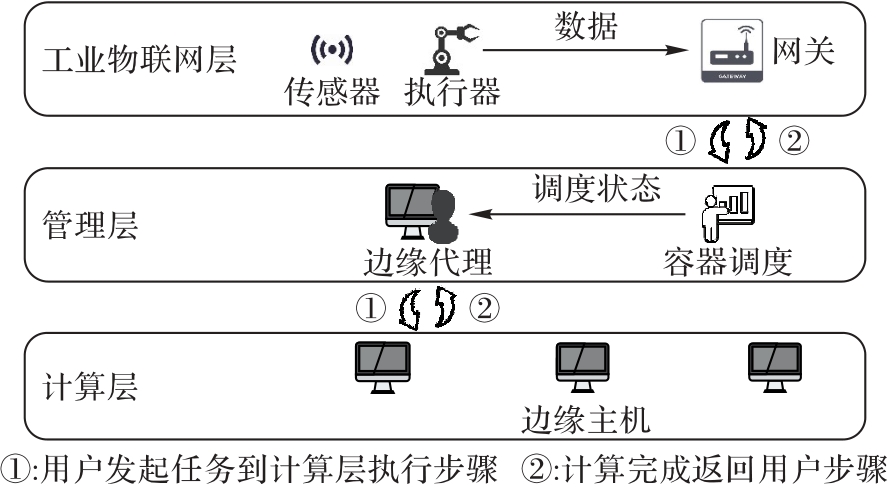
Fig. 1 Overall system architecture
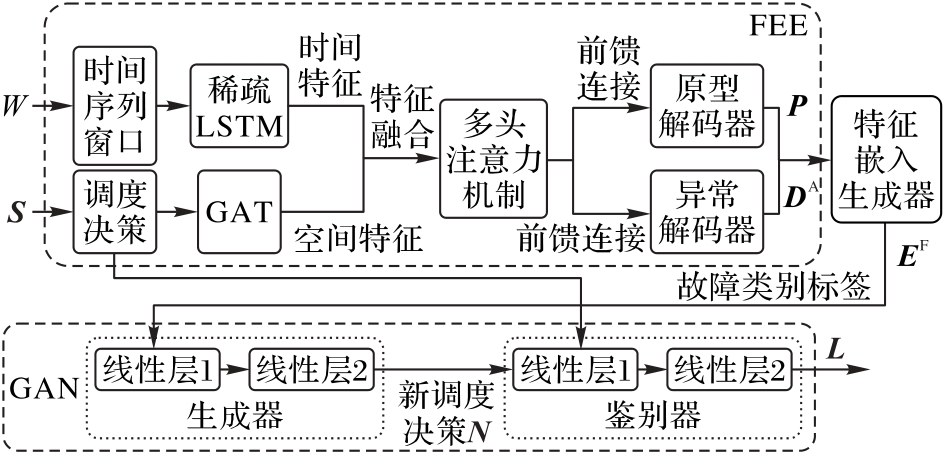
Fig. 2 Framework of SGAT-GAN method
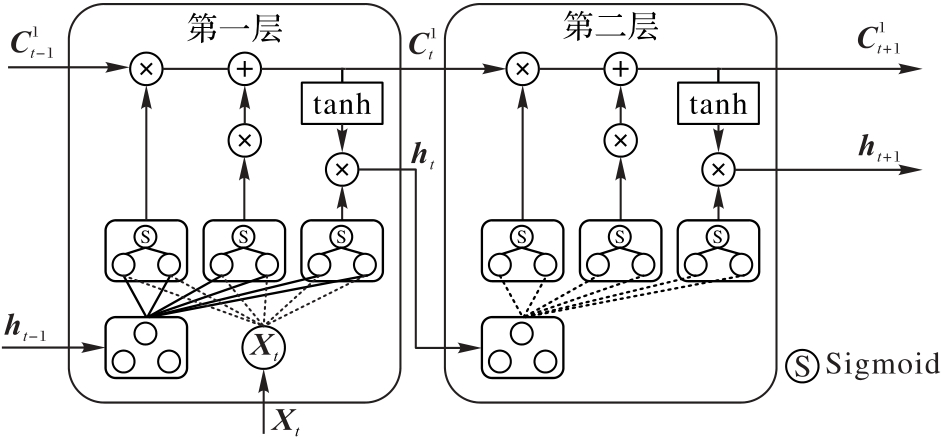
Fig. 3 Sparse LSTM-based method (first time step)
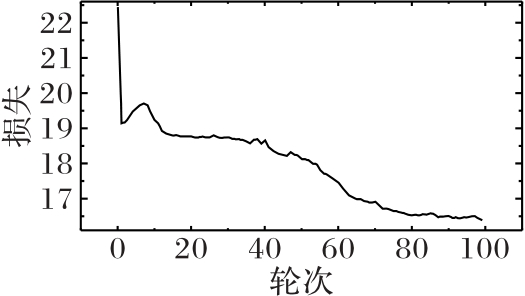
Fig. 4 Loss curve of FEE training
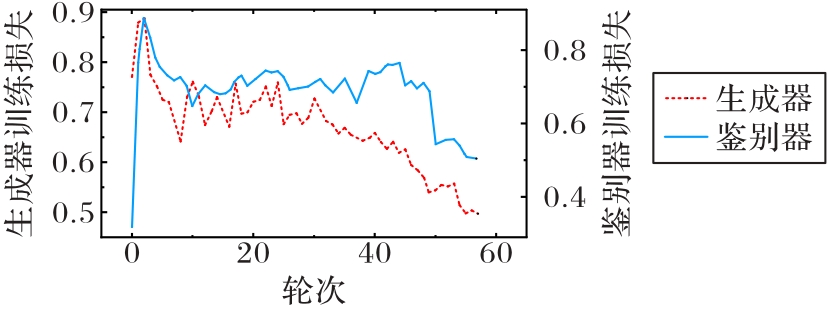
Fig. 5 Loss curves of GAN training
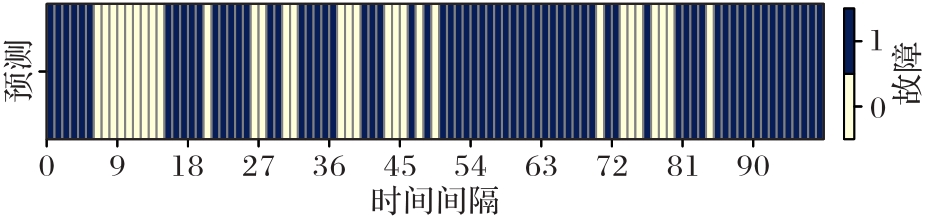
Fig. 6 Heatmap of fault intervals predicted by SGAT-GAN method
| 方法 | 准确率 | 精确率 | 召回率 | F1分数 |
|---|---|---|---|---|
| PCFT | 89.13±1.08 | 80.29±6.92 | 90.18±1.65 | 84.95±3.12 |
| CMODLB | 91.28±1.12 | 81.58±3.43 | 90.13±0.91 | 86.05±2.84 |
| DeepFT | 94.22±0.78 | 86.35±0.11 | 90.01±0.92 | 88.14±2.71 |
| PreGAN | 96.35±0.92 | 87.23±2.21 | 90.18±1.21 | 88.68±6.29 |
| SGAT-GAN | 91.74±1.47 | 89.19±1.87 | 98.82±0.20 | 93.63±1.06 |
Tab. 1 Comparison of fault detection results and standard deviations for different methods
| 方法 | 准确率 | 精确率 | 召回率 | F1分数 |
|---|---|---|---|---|
| PCFT | 89.13±1.08 | 80.29±6.92 | 90.18±1.65 | 84.95±3.12 |
| CMODLB | 91.28±1.12 | 81.58±3.43 | 90.13±0.91 | 86.05±2.84 |
| DeepFT | 94.22±0.78 | 86.35±0.11 | 90.01±0.92 | 88.14±2.71 |
| PreGAN | 96.35±0.92 | 87.23±2.21 | 90.18±1.21 | 88.68±6.29 |
| SGAT-GAN | 91.74±1.47 | 89.19±1.87 | 98.82±0.20 | 93.63±1.06 |
| 方法 | 准确率 |
|---|---|
| DeepFT | 82.27±2.58 |
| PreGAN | 91.63±2.48 |
| SGAT-GAN | 93.25±2.49 |
Tab. 2 Comparison of classification accuracy and standard deviation for different methods
| 方法 | 准确率 |
|---|---|
| DeepFT | 82.27±2.58 |
| PreGAN | 91.63±2.48 |
| SGAT-GAN | 93.25±2.49 |
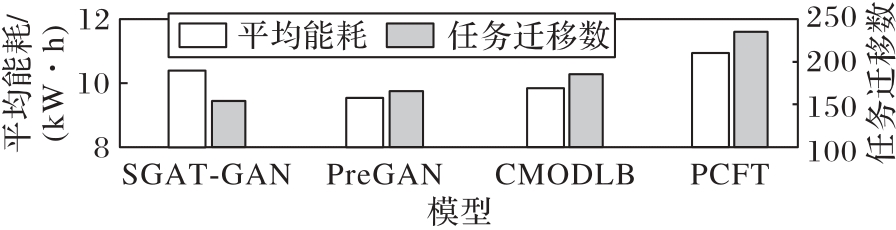
Fig. 7 Comparison of model energy consumption and transfer amount
| 时间特征提取方法 | 准确率 | F1分数 |
|---|---|---|
| GRU | 88.56±0.93 | 91.38±0.57 |
| LSTM | 91.33±2.32 | 93.37±1.65 |
| 稀疏LSTM | 91.74±1.47 | 93.63±1.06 |
Tab. 3 Comparison of experimental results for different temporal feature extraction methods
| 时间特征提取方法 | 准确率 | F1分数 |
|---|---|---|
| GRU | 88.56±0.93 | 91.38±0.57 |
| LSTM | 91.33±2.32 | 93.37±1.65 |
| 稀疏LSTM | 91.74±1.47 | 93.63±1.06 |
| 空间特征提取方法 | 准确率 | F1分数 |
|---|---|---|
| GCN | 67.84±0.46 | 80.05±0.48 |
| GIN | 78.49±2.72 | 87.51±2.47 |
| GAT | 91.74±1.47 | 93.63±1.06 |
Tab. 4 Comparison of accuracy and F1 score for different spatial feature extraction methods
| 空间特征提取方法 | 准确率 | F1分数 |
|---|---|---|
| GCN | 67.84±0.46 | 80.05±0.48 |
| GIN | 78.49±2.72 | 87.51±2.47 |
| GAT | 91.74±1.47 | 93.63±1.06 |
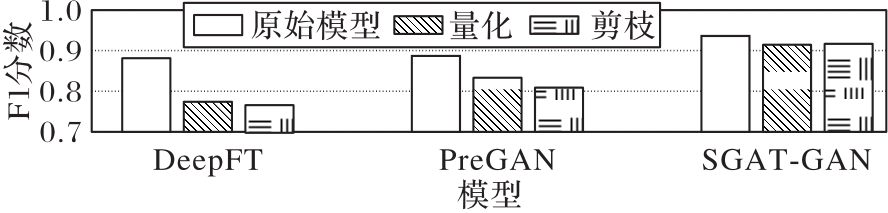
Fig. 8 Comparison of F1 score after quantization and pruning
| [1] | Xu J, Tao H, Zhang X, et al. An adaptive multisignal framework for real-time fault diagnosis of rolling bearings[J]. IEEE Transactions on Instrumentation and Measurement, 2025, 74: No.3509816. |
| [2] | Tuli S, Ilager S, Ramamohanarao K, et al. Dynamic scheduling for stochastic edge-cloud computing environments using A3C learning and residual recurrent neural networks[J]. IEEE Transactions on Mobile Computing, 2022, 21(3): 940-954. |
| [3] | Liu J, Xu H, Wang L, et al. Adaptive asynchronous federated learning in resource-constrained edge computing[J]. IEEE Transactions on Mobile Computing, 2023, 22(2): 674-690. |
| [4] | Ristov S, Fahringer T, Peer D, et al. Resilient techniques against disruptions of volatile cloud resources[M]// Rak J, Hutchison D. Guide to disaster-resilient communication networks, CCN. Cham: Springer, 2020: 379-400. |
| [5] | Ataallah S M A, Nassar S M, Hemayed E E. Fault tolerance in cloud computing — survey[C]// ICENCO 2015. Piscataway: IEEE, 2015: 241-245. |
| [6] | Sivagami V M, Easwarakumar K S. An improved dynamic fault tolerant management algorithm during VM migration in cloud data center[J]. Future Generation Computer Systems, 2019, 98: 35-43. |
| [7] | Jia Y, Wang T, Qiu T, et al. Fault tolerance of stateful microservices for industrial edge scenarios[C]// JCC 2023. Piscataway: IEEE, 2023: 50-56. |
| [8] | Wang Y Y, Hsu C P, Huang C M, et al. Fault location prediction based on customer complaint amount[C]// APNOMS 2019. Piscataway: IEEE, 2019: 1-4. |
| [9] | Shayesteh B, Ebrahimzadeh A, Glitho R. Machine learning for predicting infrastructure faults and job failures in clouds: a survey[J]. IEEE Communications Magazine, 2025, 63(1): 148-154. |
| [10] | Li J, Ding D, Tsung F. Directional PCA for fast detection and accurate diagnosis: a unified framework[J]. IEEE Transactions on Cybernetics, 2022, 52(11): 11362-11372. |
| [11] | Jia Y, Ying L, Wang D, et al. Defect prediction of relay protection systems based on LSSVM-BNDT[J]. IEEE Transactions on Industrial Informatics, 2020, 17(1): 710-719. |
| [12] | Yang Y, Mei J, Zhang Z, et al. Lightweight fault prediction method for edge networks[J]. IEEE Internet of Things Journal, 2024, 11(6): 11117-11136. |
| [13] | Huang Q, Han Y, Zhang X, et al. FFKD-CGhostNet: a novel lightweight network for fault diagnosis in edge computing scenarios[J]. IEEE Transactions on Instrumentation and Measurement, 2023, 72: No.3536410. |
| [14] | Sharif A, Nickray M, Shahidinejad A. Fault-tolerant with load balancing scheduling in a fog-based IoT application[J]. IET Communications, 2020, 14(16): 2646-2657. |
| [15] | Liu J, Wang S, Zhou A, et al. Using proactive fault-tolerance approach to enhance cloud service reliability[J]. IEEE Transactions on Cloud Computing, 2018, 6(4): 1191-1202. |
| [16] | Negi S, Rauthan M M S, Vaisla K S, et al. CMODLB: an efficient load balancing approach in cloud computing environment[J]. The Journal of Supercomputing, 2021, 77(8): 8787-8839. |
| [17] | An K, Lu J, Zhu Q, et al. Edge solution for real-time motor fault diagnosis based on efficient convolutional neural network[J]. IEEE Transactions on Instrumentation and Measurement, 2023, 72: No.3516912. |
| [18] | Xiao Y, Shao H, Lin J, et al. BCE-FL: a secure and privacy-preserving federated learning system for device fault diagnosis under non-IID condition in IIoT[J]. IEEE Internet of Things Journal, 2024, 11(8): 14241-14252. |
| [19] | Tuli S, Casale G, Cherkasova L, et al. DeepFT: fault-tolerant edge computing using a self-supervised deep surrogate model[C]// IEEE INFOCOM 2023. Piscataway: IEEE, 2023: 1-10. |
| [20] | Tuli S, Casale G, Jennings N R. PreGAN: preemptive migration prediction network for proactive fault-tolerant edge computing[C]// IEEE INFOCOM 2022. Piscataway: IEEE, 2022: 670-679. |
| [21] | Chen Y, Yang Q, He S, et al. FTPipeHD: a fault-tolerant pipeline-parallel distributed training approach for heterogeneous edge devices[J]. IEEE Transactions on Mobile Computing, 2024, 23(4): 3200-3212. |
| [22] | Al-Dulaimy A, Sicari C, Papadopoulos A V, et al. TOLERANCER: a fault tolerance approach for cloud manufacturing environments[C]// ETFA 2022. Piscataway: IEEE, 2022: 1-8. |
| [23] | Xie X, Wu X, Hu Q, et al. Multi-container migration strategy optimization for industrial robotics workflow based on hybrid tabu-evolutionary algorithm[J]. IEEE Transactions on Services Computing, 2024, 17(5): 2640-2653. |
| [24] | Tuli S, Mahmud R, Tuli S, et al. FogBus: a blockchain-based lightweight framework for edge and fog computing[J]. Journal of Systems and Software, 2019, 154: 22-36. |
| [25] | Basu D, Wang X, Hong Y, et al. Learn-as-you-go with Megh: efficient live migration of virtual machines[J]. IEEE Transactions on Parallel and Distributed Systems, 2019, 30(8): 1786-1801. |
| [26] | Tuli S, Casale G, Jennings N R. PreGAN+: semi-supervised fault prediction and preemptive migration in dynamic mobile edge environments[J]. IEEE Transactions on Mobile Computing, 2024, 23(6): 6881-6895. |
| [27] | So R Q, Kent A R, Grill W M. Relative contributions of local cell and passing fiber activation and silencing to changes in thalamic fidelity during deep brain stimulation and lesioning: a computational modeling study[J]. Journal of Computational Neuroscience, 2012, 32(3): 499-519. |
| [28] | Tuli S, Bansal R, Paul R, et al. TANGO: commonsense generalization in predicting tool interactions for mobile manipulators[C]// IJCAI 2021. California: IJCAI, 2021: 4197-4205. |
| [29] | Tuli S, Poojara S R, Srirama S N, et al. COSCO: container orchestration using co-simulation and gradient based optimization for fog computing environments[J]. IEEE Transactions on Parallel and Distributed Systems, 2022, 33(1): 101-116. |
| [30] | Vaswani A, Shazeer N, Parmar N, et al. Attention is all you need[C]// NeurIPS 2017. Red Hook: Curran Associates Inc., 2017: 6000-6010. |
| [31] | Tuli S, Gill S S, Xu M, et al. HUNTER: AI based holistic resource management for sustainable cloud computing[J]. Journal of Systems and Software, 2022, 184: No.111124. |
| [1] | Chenyang WANG, Xiaoyu SHI, Jie GAN, Mingsheng SHANG. Trajectory-aware multi-agent cooperative task offloading method for vehicular edge computing [J]. Journal of Computer Applications, 2026, 46(9): 2910-2919. |
| [2] | Guanliang CHEN, Yi LIU, Yi YU. Heterogeneous multi-agent reinforcement learning enabled co-optimization of UAV 3D obstacle avoidance and edge computing [J]. Journal of Computer Applications, 2026, 46(9): 2898-2909. |
| [3] | Juan CHEN, Yujie CHEN, Zongling WU, Di TIAN, Jie ZHONG. User-centric satellite edge computing architecture for task offloading optimization [J]. Journal of Computer Applications, 2026, 46(8): 2524-2532. |
| [4] | Xuan CUI, Bo LIU. Unsupervised face attribute editing method based on dynamic convolutional autoencoder [J]. Journal of Computer Applications, 2026, 46(4): 1300-1308. |
| [5] | Min CHEN, Xiaolin QIN, Shaohan LI, Hao YANG, Taohong LI. Review of deep learning applications in severe convective weather prediction [J]. Journal of Computer Applications, 2026, 46(3): 980-992. |
| [6] | Bing GAO, Jinzhuo LIN, Qijie ZOU, Yongqiang YAO. Zero-shot knowledge graph relation prediction method via dual-channel embedding fusion [J]. Journal of Computer Applications, 2026, 46(10): 3117-3123. |
| [7] | Yinlong JIAN, Xuebin CHEN, Zhongrui JING, Qi ZHONG, Zhenbo ZHANG. Data augmentation scheme based on conditional generative adversarial network in federated learning [J]. Journal of Computer Applications, 2026, 46(1): 21-32. |
| [8] | Na FAN, Chuang LUO, Zehui ZHANG, Mengyao ZHANG, Ding MU. Semantic privacy protection mechanism of vehicle trajectory based on improved generative adversarial network [J]. Journal of Computer Applications, 2026, 46(1): 169-180. |
| [9] | Lifang WANG, Wenjing REN, Xiaodong GUO, Rongguo ZHANG, Lihua HU. Trident generative adversarial network for low-dose CT image denoising [J]. Journal of Computer Applications, 2026, 46(1): 270-279. |
| [10] | Yilin DENG, Fajiang YU. Pseudo random number generator based on LSTM and separable self-attention mechanism [J]. Journal of Computer Applications, 2025, 45(9): 2893-2901. |
| [11] | Jin ZHOU, Yuzhi LI, Xu ZHANG, Shuo GAO, Li ZHANG, Jiachuan SHENG. Modulation recognition network for complex electromagnetic environments [J]. Journal of Computer Applications, 2025, 45(8): 2672-2682. |
| [12] | Ying HUANG, Shengmei GAO, Guang CHEN, Su LIU. Low-light image enhancement network combining signal-to-noise ratio guided dual-branch structure and histogram equalization [J]. Journal of Computer Applications, 2025, 45(6): 1971-1979. |
| [13] | Tianyu XUE, Aiping LI, Liguo DUAN. Vehicular edge computing scheme with task offloading and resource optimization [J]. Journal of Computer Applications, 2025, 45(6): 1766-1775. |
| [14] | Yiming ZHANG, Tengfei CAO. Federated learning optimization algorithm based on local drift and diversity computing power [J]. Journal of Computer Applications, 2025, 45(5): 1447-1454. |
| [15] | Hui LI, Bingzhi JIA, Chenxi WANG, Ziyu DONG, Jilong LI, Zhaoman ZHONG, Yanyan CHEN. Generative adversarial network underwater image enhancement model based on Swin Transformer [J]. Journal of Computer Applications, 2025, 45(5): 1439-1446. |
| Viewed | ||||||
|
Full text |
|
|||||
|
Abstract |
|
|||||
