


《计算机应用》唯一官方网站 ›› 2026, Vol. 46 ›› Issue (9): 2847-2856.DOI: 10.11772/j.issn.1001-9081.2025081037
• 数据科学与技术 • 上一篇
周东阳, 杜金莲( ), 金雪云
收稿日期:2025-09-10
修回日期:2025-10-25
接受日期:2025-11-11
发布日期:2025-11-18
出版日期:2026-09-10
通讯作者:
杜金莲
作者简介:周东阳(2000—),男,安徽合肥人,硕士研究生,主要研究方向:知识图谱、数据可视化
Dongyang ZHOU, Jinlian DU(), Xueyun JIN
Received:2025-09-10
Revised:2025-10-25
Accepted:2025-11-11
Online:2025-11-18
Published:2026-09-10
Contact:
Jinlian DU
About author:ZHOU Dongyang, born in 2000, M. S. candidate. His research interests include knowledge graph, data visualization.摘要:
力导向布局方法是知识图谱可视化采用的经典方法,它通过节点间的引力和排斥力将节点均匀地分布在可视化空间内。但垂直领域的知识图谱可视化常与领域应用密切相关,经典的力导向布局方法不能满足垂直领域知识图谱的可视化需求。因此,以支持临床辅助诊疗应用的病历知识图谱可视化技术为目的,通过分析病历知识图谱的图结构、数据特点以及查询应用的可视化需求,提出改进的力导向布局方法。该方法在经典力导向布局模型的基础上引入同级同类型节点间引力、同级异类型节点间排斥力和非叶且非邻接节点间维持间距排斥力,使在布局上同级同类型节点能集中在同一个区域,同级不同类型节点分布到不同的区域,不同级别的节点以合理的间距分布,从而减少节点挤压和边交叉现象,使最终生成的可视化布局能清晰地展示数据的类型特征、数量特征和社区特征。此外,将节点的类型和同级同类型节点数作为决定节点间边长的因子,并通过边的长度表达节点的重要性,从而进一步提升可视化布局的合理性,以强化语义的可视化表达。实验结果表明,在垂直领域语义可视化能力方面,本文方法的节点类型空间区分度(NTSD)均值相较于FR(Fruchterman-Reingold)方法平均提升了165.5%。从可视化结果来看,该方法在电子病历知识图谱可视化上获得了更好的效果。
中图分类号:
周东阳, 杜金莲, 金雪云. 面向病历知识图谱展示应用的力导向布局可视化方法[J]. 计算机应用, 2026, 46(9): 2847-2856.
Dongyang ZHOU, Jinlian DU, Xueyun JIN. Force-directed layout visualization method for medical record knowledge graph presentation applications[J]. Journal of Computer Applications, 2026, 46(9): 2847-2856.
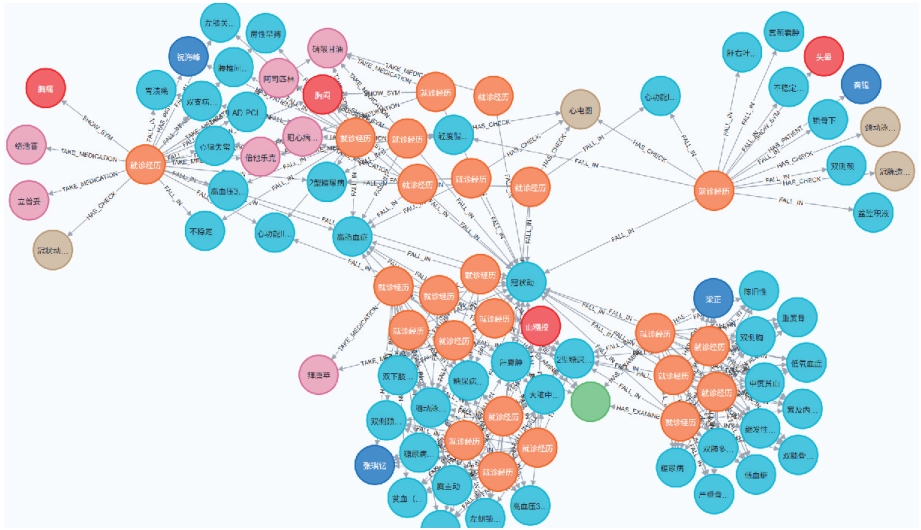
图1 经典力导向布局可视化的病历知识图谱
Fig. 1 Classical force-directed layout visualization for knowledge graph of medical records

图2 节点间力的作用方向的示意图
Fig. 2 Schematic diagram of directions of forces between nodes
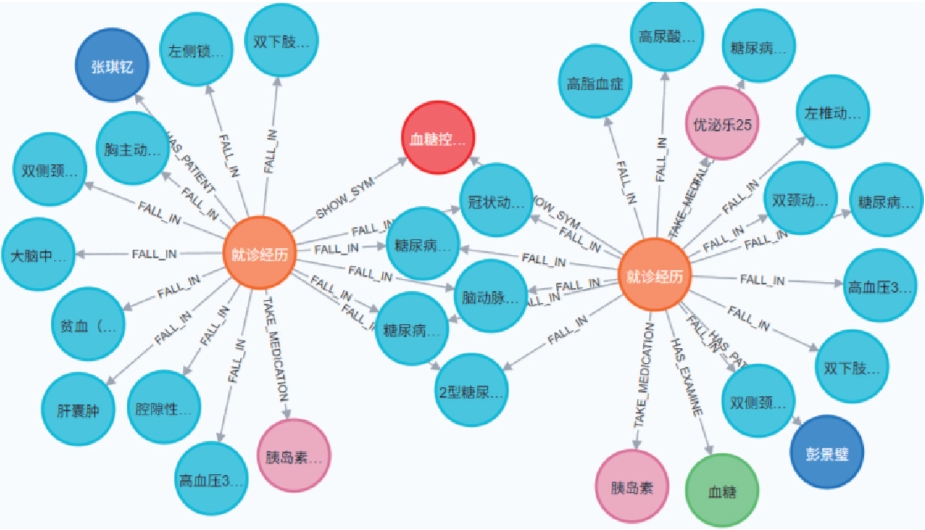
图 3 经典力导向布局下的节点分布
Fig. 3 Node distribution under classical force-directed layout
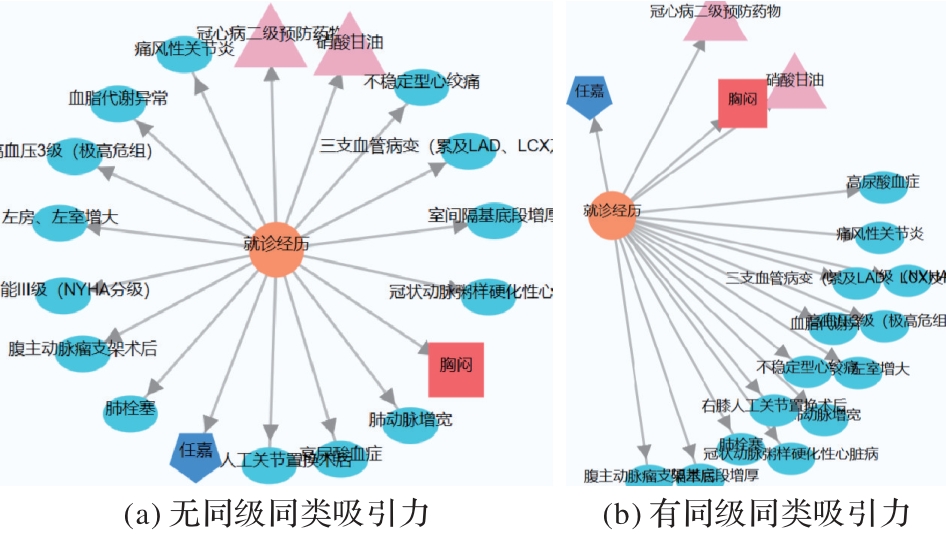
图4 添加同级同类吸引力前后的效果对比
Fig. 4 Comparison of effects before and after adding attractive force for same level and same type
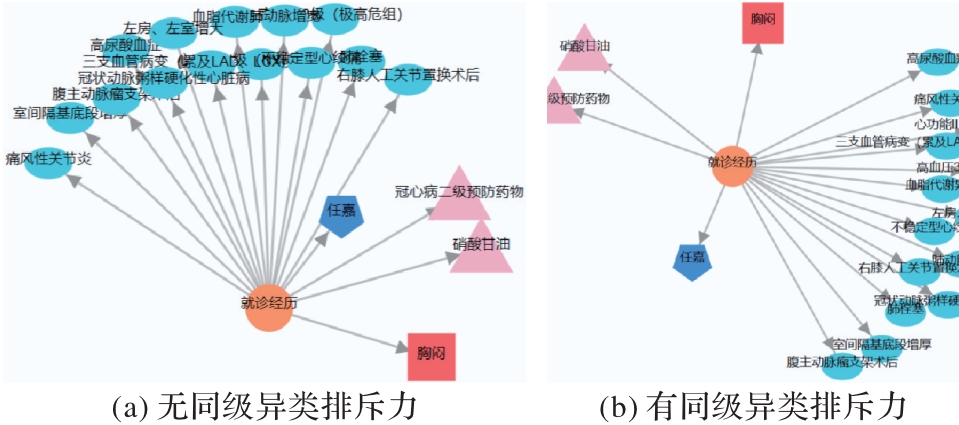
图5 添加同级异类排斥力前后的效果对比
Fig. 5 Comparison of effects before and after adding repulsive force for heterogeneous same level and different types
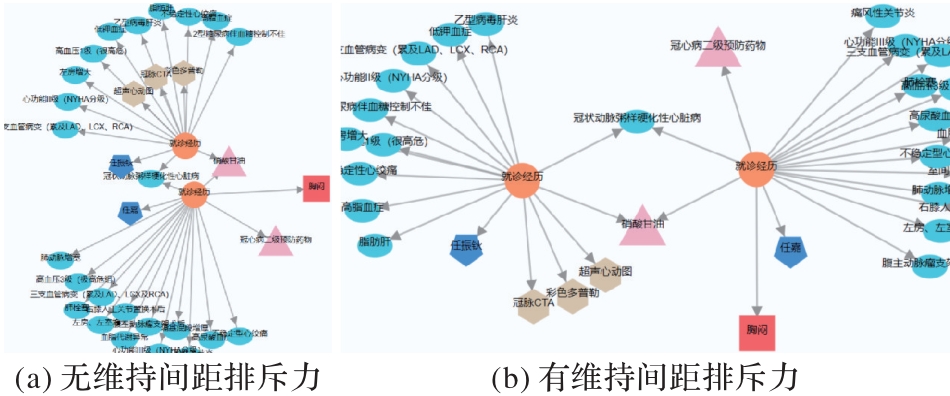
图6 添加维持间距的排斥力前后的效果对比
Fig. 6 Comparison of effects before and after adding repulsive force to maintain spacing

图7 节点间距的示意图
Fig. 7 Schematic diagram of node spacing
| 节点数 | 边数 | 平均时间/s |
|---|---|---|
| 69 | 173 | 2.830 |
| 372 | 880 | 15.578 |
| 694 | 1 720 | 30.392 |
| 1 108 | 3 441 | 99.229 |
表1 在不同子图规模下的布局生成时间
Tab. 1 Layout generation time under different subgraph scales
| 节点数 | 边数 | 平均时间/s |
|---|---|---|
| 69 | 173 | 2.830 |
| 372 | 880 | 15.578 |
| 694 | 1 720 | 30.392 |
| 1 108 | 3 441 | 99.229 |
| 标签 | 描述 | 实体数 | 负载数据 |
|---|---|---|---|
| Diagnosis | 疾病 | 6 006 | Id, label, name |
| Examination | 检查 | 350 | Id, label, name |
| Detection | 检验 | 256 | Id, label, name |
| MajorSymptom | 症状 | 988 | Id, label, name |
| MedicationTreatment | 治疗 | 545 | Id, label, name |
| Patient | 患者 | 2 000 | Id, age, gender, label, name, patientSN |
| M-E | 就诊经历 | 2 120 | Id, label, EXPTIME, EXP_ID, MR_ID, |
表2 电子病历知识图谱实体数据
Tab. 2 Knowledge graph entity data for electronic medical record
| 标签 | 描述 | 实体数 | 负载数据 |
|---|---|---|---|
| Diagnosis | 疾病 | 6 006 | Id, label, name |
| Examination | 检查 | 350 | Id, label, name |
| Detection | 检验 | 256 | Id, label, name |
| MajorSymptom | 症状 | 988 | Id, label, name |
| MedicationTreatment | 治疗 | 545 | Id, label, name |
| Patient | 患者 | 2 000 | Id, age, gender, label, name, patientSN |
| M-E | 就诊经历 | 2 120 | Id, label, EXPTIME, EXP_ID, MR_ID, |
| 标签 | 关系方向 | 关系数 |
|---|---|---|
| FALL_IN | 就诊经历→疾病 | 27 030 |
| HAS_CHECK | 就诊经历→检查 | 1 575 |
| HAS_EXAMINE | 就诊经历→检验 | 761 |
| HAS_PATIENT | 就诊经历→患者 | 2 120 |
| SHOW_SYM | 就诊经历→症状(主症状、 伴随症状、无症状) | 2 729 |
| TAKE_MEDICATION | 就诊经历→治疗(手术治疗、 药物治疗) | 1 878 |
表3 电子病历知识图谱关系数据
Tab. 3 Knowledge graph relationship data for electronic medical record
| 标签 | 关系方向 | 关系数 |
|---|---|---|
| FALL_IN | 就诊经历→疾病 | 27 030 |
| HAS_CHECK | 就诊经历→检查 | 1 575 |
| HAS_EXAMINE | 就诊经历→检验 | 761 |
| HAS_PATIENT | 就诊经历→患者 | 2 120 |
| SHOW_SYM | 就诊经历→症状(主症状、 伴随症状、无症状) | 2 729 |
| TAKE_MEDICATION | 就诊经历→治疗(手术治疗、 药物治疗) | 1 878 |

图8 节点颜色和形状含义说明
Fig. 8 Explanation of node colors and shapes
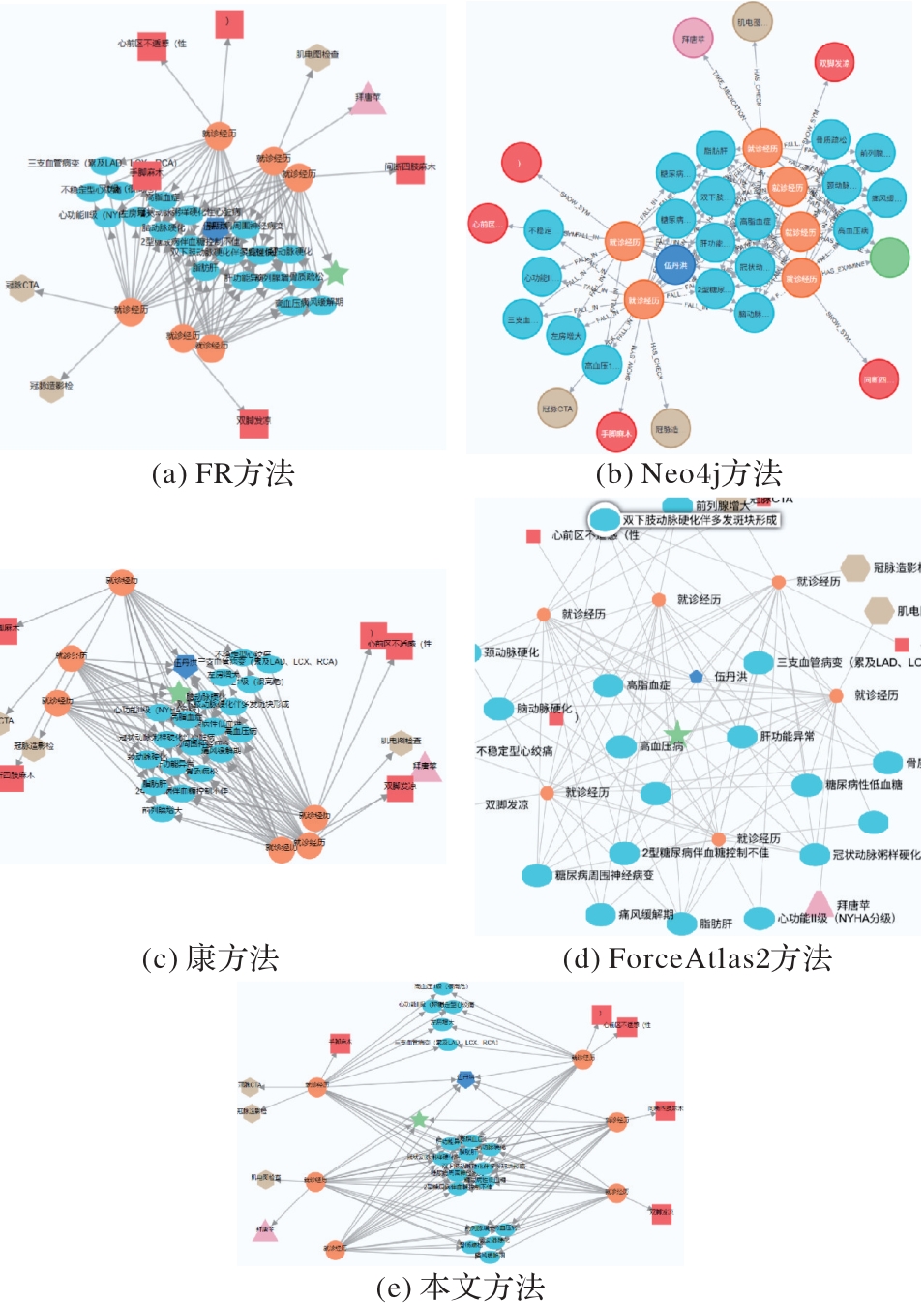
图9 5种方法的可视化结果(查询1)
Fig. 9 Visualization results of five methods (Query 1)
| 方法 | 查询1 | 查询2 | ||
|---|---|---|---|---|
| NTSD均值 | NTSD标准差 | NTSD均值 | NTSD标准差 | |
| FR方法 | 1.539 5 | 0.684 0 | 2.243 0 | 0.123 7 |
| Neo4j方法 | 2.320 0 | 0.279 5 | 2.352 3 | 0.304 0 |
| 康方法 | 3.383 5 | 0.244 5 | 3.335 3 | 0.185 0 |
| ForceAtlas2方法 | 1.338 5 | 0.067 3 | 2.215 8 | 0.165 5 |
| 本文方法 | 5.060 7 | 0.420 5 | 4.536 3 | 0.349 5 |
表4 NTSD的相关统计结果
Tab. 4 Relevant statistical results of NTSD
| 方法 | 查询1 | 查询2 | ||
|---|---|---|---|---|
| NTSD均值 | NTSD标准差 | NTSD均值 | NTSD标准差 | |
| FR方法 | 1.539 5 | 0.684 0 | 2.243 0 | 0.123 7 |
| Neo4j方法 | 2.320 0 | 0.279 5 | 2.352 3 | 0.304 0 |
| 康方法 | 3.383 5 | 0.244 5 | 3.335 3 | 0.185 0 |
| ForceAtlas2方法 | 1.338 5 | 0.067 3 | 2.215 8 | 0.165 5 |
| 本文方法 | 5.060 7 | 0.420 5 | 4.536 3 | 0.349 5 |
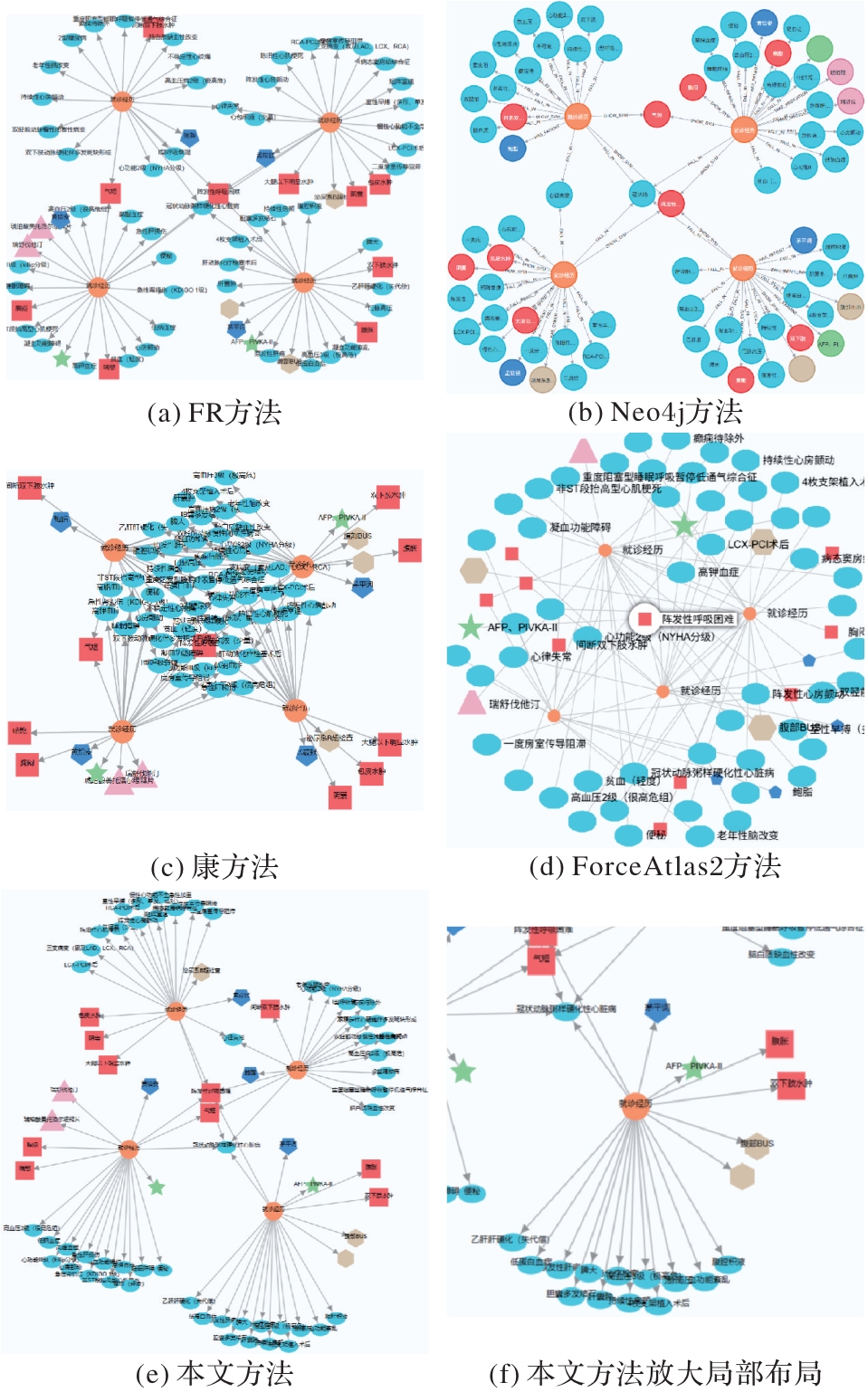
图10 5种方法的可视化结果(查询2)
Fig. 10 Visualization results of five methods (Query 2)
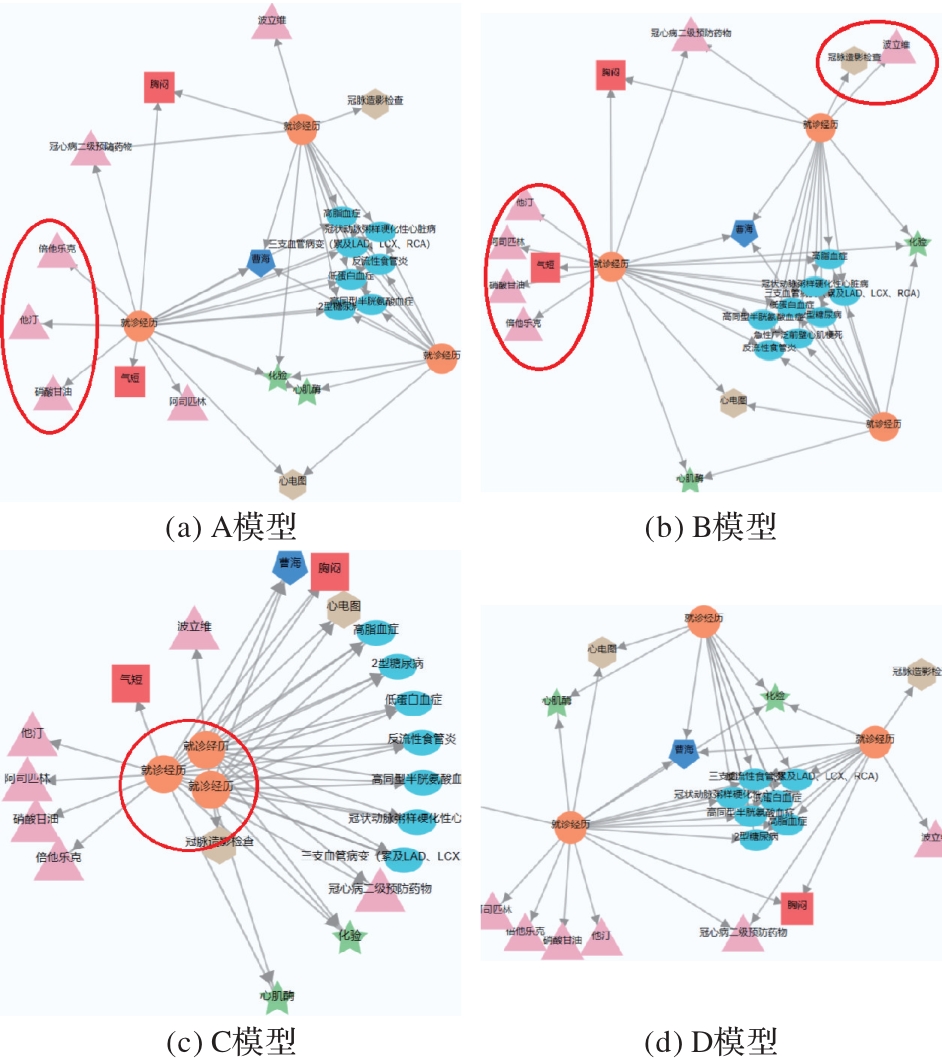
图11 4种模型的可视化结果(查询1)
Fig. 11 Visualization results of four models (Query 1)
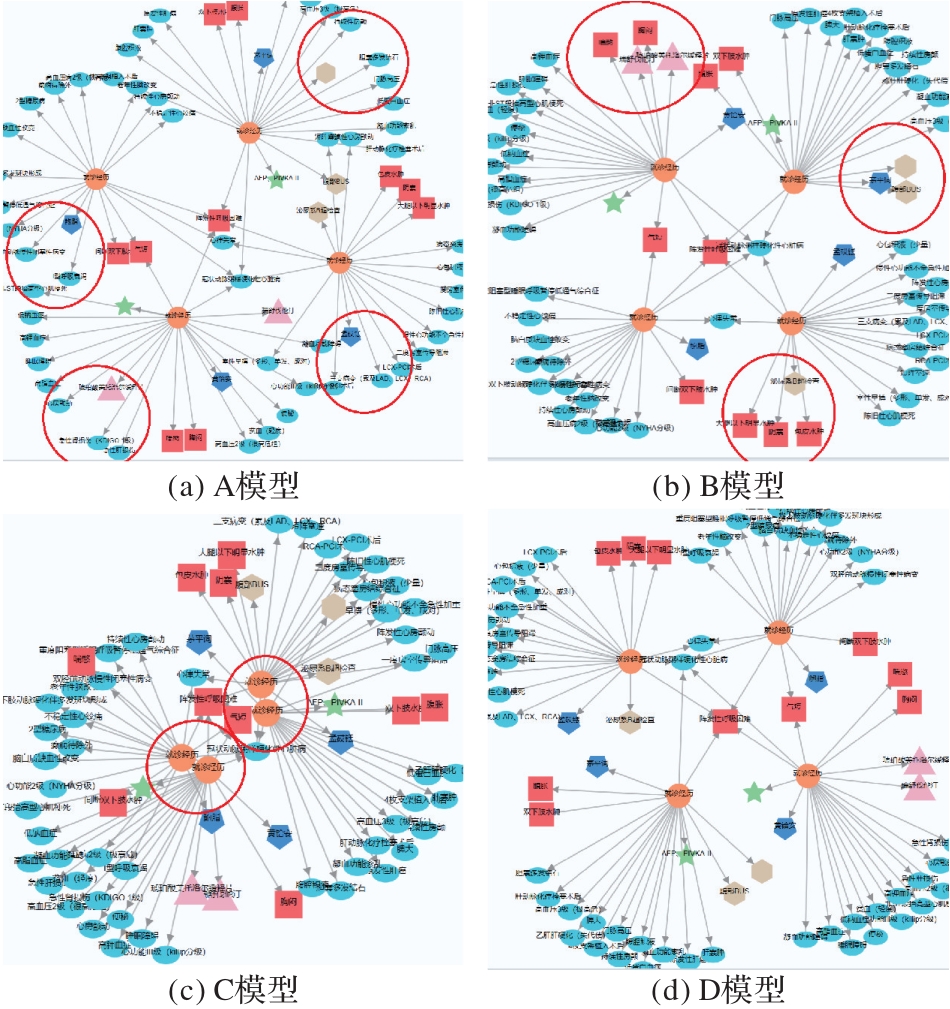
图12 4种模型的可视化结果(查询2)
Fig. 12 Visualization results of four models (Query 2)
| [1] | Chandak P, Huang K, Zitnik M. Building a knowledge graph to enable precision medicine [J]. Scientific Data, 2023, 10: No.67. |
| [2] | Hu X, Wang L, Wei Q, et al. Research on time-series visualization methods for scientific and technical consulting graph data[C]// FRSE 2023. Piscataway: IEEE, 2023: 393-400. |
| [3] | Fruchterman T M J, Reingold E M. Graph drawing by force-directed placement [J]. Software: Practice and Experience, 1991, 21(11): 1129-1164. |
| [4] | 杨卓,谢雅淇,陈谊,等. 图可视化布局方法最新研究进展综述[J]. 计算机工程与应用, 2023, 59(16): 1-15. |
| Yang Zhuo, Xie Yaqi, Chen Yi, et al. Review of latest research for layout methods of graph visualization [J]. Computer Engineering and Applications, 2023, 59(16): 1-15. | |
| [5] | Zhou H, Huang S, Zheng Y, et al. DKGV: a dynamic knowledge graph visualization method based on force-directed layout [C]// VRCAI 2024. New York: ACM, 2024: No.3. |
| [6] | Hu Y. Efficient, high-quality force-directed graph drawing [J]. The Mathematica Journal, 2005, 10(1): 37-71. |
| [7] | Walshaw C. A multilevel algorithm for force-directed graph drawing[C]// GD 2000, LNCS 1984. Berlin: Springer, 2001: 171-182. |
| [8] | Noack A. An energy model for visual graph clustering[C]// International Symposium on Graph Drawing. Berlin: Springer, 2003: 425-436. |
| [9] | Jacomy M, Venturini T, Heymann S, et al. ForceAtlas2, a continuous graph layout algorithm for handy network visualization designed for the Gephi software [J]. PLoS ONE, 2014, 9(6): No.e98679. |
| [10] | Grama A Y, Kumar V, Sameh A. Scalable parallel formulations of the Barnes-Hut method for n-body simulations [C]// Supercomputing 1994. Piscataway: IEEE, 1994: 439-448. |
| [11] | 康健梓,周虹. 基于力导向布局的知识图谱可视化方法[J]. 计算机辅助设计与图形学学报, 2024, 36(8): 1214-1223. |
| Kang Jianzi, Zhou Hong. Force-directed layout based knowledge graph visualization method [J]. Journal of Computer-Aided Design and Computer Graphics, 2024, 36(8): 1214-1223. | |
| [12] | Purchase H C. Metrics for graph drawing aesthetics [J]. Journal of Visual Languages and Computing, 2002, 13(5): 501-516. |
| [13] | Du F, Cao N, Lin Y R, et al. iSphere: Focus+context sphere visualization for interactive large graph exploration [C]// CHI 2017. New York: ACM, 2017: 2916-2927. |
| [14] | Ahmed R, de Luca F, Devkota S, et al. Graph drawing via gradient descent, (GD)2 [C]// GD 2020, LNCS 12590. Cham: Springer, 2020: 3-17. |
| [15] | 王鑫,傅强,王林,等. 知识图谱可视化查询技术综述[J]. 计算机工程, 2020, 46(6): 1-11. |
| Wang Xin, Fu Qiang, Wang Lin, et al. Survey on visualization query technology of knowledge graph[J]. Computer Engineering, 2020, 46(6): 1-11. | |
| [16] | 王勇超,罗胜文,杨英宝,等. 知识图谱可视化综述[J]. 计算机辅助设计与图形学学报, 2019, 31(10): 1666-1676. |
| Wang Yongchao, Luo Shengwen, Yang Yingbao, et al. A survey on knowledge graph visualization[J]. Journal of Computer-Aided Design and Computer Graphics, 2019, 31(10): 1666-1676. | |
| [17] | 陈谊,张梦录,万玉钗. 图的表示与可视化方法综述[J]. 系统仿真学报, 2020, 32(7): 1232-1243. |
| Chen Yi, Zhang Menglu, Wan Yuchai. A survey on graph representation and visualization techniques [J]. Journal of System Simulation, 2020, 32(7): 1232-1243. | |
| [18] | 王春杰,何进荣,王文发. 基于图的多视角聚类算法综述[J]. 计算机与数字工程, 2022, 50(2): 229-237, 255. |
| Wang Chunjie, He Jinrong, Wang Wenfa. A survey of graph-based multi-view clustering algorithms [J]. Computer and Digital Engineering, 2022, 50(2): 229-237, 255. | |
| [19] | Santos A, Colaço A R, Nielsen A B, et al. Clinical knowledge graph integrates proteomics data into clinical decision-making [PP/OL]. bioRxiv (2020-05-10) [2025-07-09].. |
| [20] | Gong F, Wang M, Wang H, et al. SMR: medical knowledge graph embedding for safe medicine recommendation [J]. Big Data Research, 2021, 23: 100174. |
| [21] | Zhou C, Wang Z, Jiang Z. Construction of medical knowledge atlas and information visualization [C]// ICCIR 2022. New York: ACM, 2022: 247-253. |
| [22] | Peng J, Xu D, Lee R, et al. Expediting knowledge acquisition by a web framework for Knowledge Graph Exploration and Visualization (KGEV): case studies on COVID-19 and Human Phenotype Ontology [J]. BMC Medical Informatics and Decision Making, 2022, 22(): 147. |
| [23] | Du J, Duan S, Jin X, et al. The methodology of mapping relational data to graph data for the construction of knowledge graph in Chinese medical records [C]// SPIE 13208, IC-BIS 2024. Bellingham, WA: SPIE, 2024: No.1320826. |
| [24] | Kamada T, Kawai S. An algorithm for drawing general undirected graphs [J]. Information Processing Letters, 1989, 31(1): 7-15. |
| [1] | 崔伟, 张平, 肖卓凌, 陈卓航. 基于视觉SLAM的增量式语义建图系统[J]. 《计算机应用》唯一官方网站, 2026, 46(9): 2800-2808. |
| [2] | 姬张建, 王思源. 基于增强低频小波注意力机制的轻量化人体姿态估计框架[J]. 《计算机应用》唯一官方网站, 2026, 46(9): 2787-2792. |
| [3] | 陈江彦, 王彦丹, 刘翼虎, 马应龙. 基于协同查询优化的长尾目标检测框架[J]. 《计算机应用》唯一官方网站, 2026, 46(9): 2769-2775. |
| [4] | 贾亮 王慧杰. 基于DEIM的无人机视角目标检测算法[J]. 《计算机应用》唯一官方网站, 0, (): 0-0. |
| [5] | 赵润东 张士龙 杜帅帅 刘延东. 端到端的机油标签文本检测识别方法[J]. 《计算机应用》唯一官方网站, 0, (): 0-0. |
| [6] | 李钧玮 陈波. 基于多尺度金字塔自适应Wasserstein几何约束的医学图像分割[J]. 《计算机应用》唯一官方网站, 0, (): 0-0. |
| [7] | 张茜 陈帅 许敏 高亮 颜克荣. 基于改进DEIM的钛合金连接件表面缺陷检测方法[J]. 《计算机应用》唯一官方网站, 0, (): 0-0. |
| [8] | 杨济源 郭涛 韩锦祖 刘晓峰 王震维 李凡颖. 精确小型无人机检测模型UAV-Net[J]. 《计算机应用》唯一官方网站, 0, (): 0-0. |
| [9] | 朱广锐 徐国天 武雯欣. 融合层次领域专家与图文歧义判别的谣言检测[J]. 《计算机应用》唯一官方网站, 0, (): 0-0. |
| [10] | 邱原, 彭海龙, 费蓉, 徐庆征, 李仟禧, 薛诚. 多视图注意力融合的引文网络学术群体识别[J]. 《计算机应用》唯一官方网站, 2026, 46(8): 2494-2504. |
| [11] | 刘明, 沈东奇, 孟子洋. 双分支结构下多层次特征融合的点云配准网络[J]. 《计算机应用》唯一官方网站, 2026, 46(8): 2584-2593. |
| [12] | 刘凤春, 邵馨莹, 张春英, 王立亚, 任静. 多尺度特征优化的单目深度估计框架FCMdepth[J]. 《计算机应用》唯一官方网站, 2026, 46(8): 2603-2611. |
| [13] | 闫江毓, 王世乾, 王红. 基于改进带梯度惩罚的Wasserstein生成对抗网络和时频特征融合的窃电检测方法[J]. 《计算机应用》唯一官方网站, 2026, 46(8): 2691-2698. |
| [14] | 汤莉, 张健宇, 姚睿. 基于改进YOLOv11的雾天目标检测算法[J]. 《计算机应用》唯一官方网站, 2026, 46(8): 2630-2639. |
| [15] | 白杰龙, 方晨韵, 乔志伟. 基于多尺度注意力自适应融合的稀疏CT伪影抑制Transformer网络[J]. 《计算机应用》唯一官方网站, 2026, 46(8): 2660-2667. |
| 阅读次数 | ||||||
|
全文 |
|
|||||
|
摘要 |
|
|||||
