


《计算机应用》唯一官方网站 ›› 2026, Vol. 46 ›› Issue (5): 1634-1646.DOI: 10.11772/j.issn.1001-9081.2025101275
• 前沿与综合应用 • 上一篇
崔凯燕, 魏舒娜( )
)
收稿日期:2025-10-31
修回日期:2026-01-18
接受日期:2026-01-20
发布日期:2026-01-29
出版日期:2026-05-10
通讯作者:
魏舒娜
作者简介:崔凯燕(1992—),女,山西长治人,讲师,博士,主要研究方向:贝叶斯统计、医学图像处理
基金资助:Received:2025-10-31
Revised:2026-01-18
Accepted:2026-01-20
Online:2026-01-29
Published:2026-05-10
Contact:
Shuna WEI
About author:CUI Kaiyan, born in 1992, Ph. D., lecturer. Her research interests include Bayesian statistics, medical image processing.
Supported by:摘要:
磁共振成像(MRI)全采样扫描时间长,既制约检测效率,还易因受检者移动产生运动伪影。针对传统压缩感知MRI(CS-MRI)重建方法参数敏感性高、无法量化结果不确定性等问题,提出一种基于小波域稀疏贝叶斯学习(SBL)的非确定性MRI重建方法BU-MRI(Bayesian Uncertainty-guided MRI)。首先利用小波变换对图像进行多分辨率表征的优势,通过刻画MRI图像在小波域中的稀疏性作为先验,构建一个分层贝叶斯概率模型。其次,采用吉布斯(Gibbs)采样与边际似然最大化相结合的后验推断策略,实现对高维稀疏系数的有效估计与超参数的自适应更新。最后,基于更新后的模型参数,从欠采样的K空间数据中迭代恢复出高质量图像。此外,该方法还能够输出像素级的后验置信区间,为重建结果提供定量化的不确定性评估。仿真与真实MRI数据上的实验结果表明,BU-MRI方法的峰值信噪比(PSNR)与结构相似性指数(SSIM)优于零填充逆离散傅里叶变换(ZF-IDFT)和k-t鲁棒主成分分析(k-t RPCA)等方法;而且在真实心脏MRI数据和大脑MRI数据上,当采样率为0.5时,BU-MRI重建数据的PSNR分别达到44.42 dB和40.37 dB,SSIM分别达到0.976 5和0.954 7。BU-MRI方法在结构保真、误差抑制与频域一致性上表现优异,在不同采样率与噪声水平下收敛稳定且鲁棒性良好,能为临床MRI提供可靠且具备不确定性量化能力的重建框架。
中图分类号:
崔凯燕, 魏舒娜. 基于小波域稀疏贝叶斯学习的非确定性MRI重建[J]. 计算机应用, 2026, 46(5): 1634-1646.
Kaiyan CUI, Shuna WEI. Wavelet-domain sparse Bayesian learning for uncertainty-aware MRI reconstruction[J]. Journal of Computer Applications, 2026, 46(5): 1634-1646.
| 符号 | 含义 |
|---|---|
| 真实图像数据向量化后的列向量 | |
| 原始的观测数据向量 | |
| K空间欠采样掩码矩阵 | |
| 线性变换矩阵 | |
| 噪声矩阵 | |
| 傅里叶变换矩阵 | |
| 小波变换矩阵 | |
| 完整K空间数据 | |
| 掩码向量化后的列向量 | |
| 真实图像数据矩阵 | |
| 观测到的噪声向量 | |
| 传感矩阵 | |
| 先验分布的超参数向量 | |
| 超参数向量构成的对角精度矩阵 | |
| 分块的先验精度矩阵 | |
中间计算变量,正比于传感矩阵的共轭转置与 观测向量的乘积 | |
| 后验均值向量 | |
| 后验协方差矩阵对角线元素 | |
| 单位阵 |
表1 主要符号说明
Tab. 1 Description of main symbols
| 符号 | 含义 |
|---|---|
| 真实图像数据向量化后的列向量 | |
| 原始的观测数据向量 | |
| K空间欠采样掩码矩阵 | |
| 线性变换矩阵 | |
| 噪声矩阵 | |
| 傅里叶变换矩阵 | |
| 小波变换矩阵 | |
| 完整K空间数据 | |
| 掩码向量化后的列向量 | |
| 真实图像数据矩阵 | |
| 观测到的噪声向量 | |
| 传感矩阵 | |
| 先验分布的超参数向量 | |
| 超参数向量构成的对角精度矩阵 | |
| 分块的先验精度矩阵 | |
中间计算变量,正比于传感矩阵的共轭转置与 观测向量的乘积 | |
| 后验均值向量 | |
| 后验协方差矩阵对角线元素 | |
| 单位阵 |
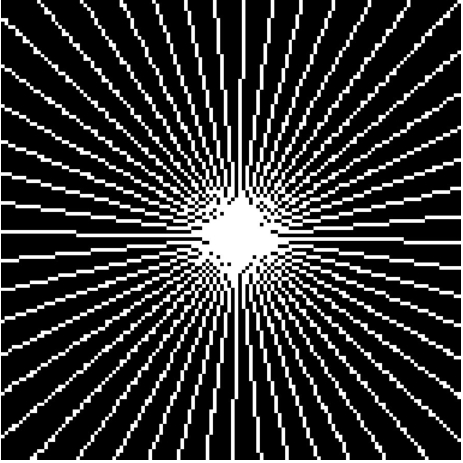
图1 径向采样图
Fig. 1 Radial sampling diagram
高斯噪声 标准差 | 采样率p=0.20 | 采样率p=0.25 | 采样率p=0.30 | 采样率p=0.40 | 采样率p=0.50 | |||||
|---|---|---|---|---|---|---|---|---|---|---|
| PSNR/dB | SSIM | PSNR/dB | SSIM | PSNR/dB | SSIM | PSNR/dB | SSIM | PSNR/dB | SSIM | |
| 28.75 | 0.465 0 | 29.99 | 0.495 8 | 31.01 | 0.523 1 | 32.15 | 0.541 7 | 33.20 | 0.558 2 | |
| 28.87 | 0.475 1 | 30.23 | 0.511 3 | 31.20 | 0.537 9 | 32.54 | 0.574 3 | 34.02 | 0.610 1 | |
| 28.58 | 0.463 9 | 30.17 | 0.510 5 | 31.02 | 0.526 9 | 32.57 | 0.575 5 | 33.95 | 0.607 2 | |
表2 仿真数据集图像在不同噪声及采样率下的PSNR与SSIM对比
Tab. 2 Comparison of PSNR and SSIM for simulated image dataset at different noise levels and sampling rates
高斯噪声 标准差 | 采样率p=0.20 | 采样率p=0.25 | 采样率p=0.30 | 采样率p=0.40 | 采样率p=0.50 | |||||
|---|---|---|---|---|---|---|---|---|---|---|
| PSNR/dB | SSIM | PSNR/dB | SSIM | PSNR/dB | SSIM | PSNR/dB | SSIM | PSNR/dB | SSIM | |
| 28.75 | 0.465 0 | 29.99 | 0.495 8 | 31.01 | 0.523 1 | 32.15 | 0.541 7 | 33.20 | 0.558 2 | |
| 28.87 | 0.475 1 | 30.23 | 0.511 3 | 31.20 | 0.537 9 | 32.54 | 0.574 3 | 34.02 | 0.610 1 | |
| 28.58 | 0.463 9 | 30.17 | 0.510 5 | 31.02 | 0.526 9 | 32.57 | 0.575 5 | 33.95 | 0.607 2 | |
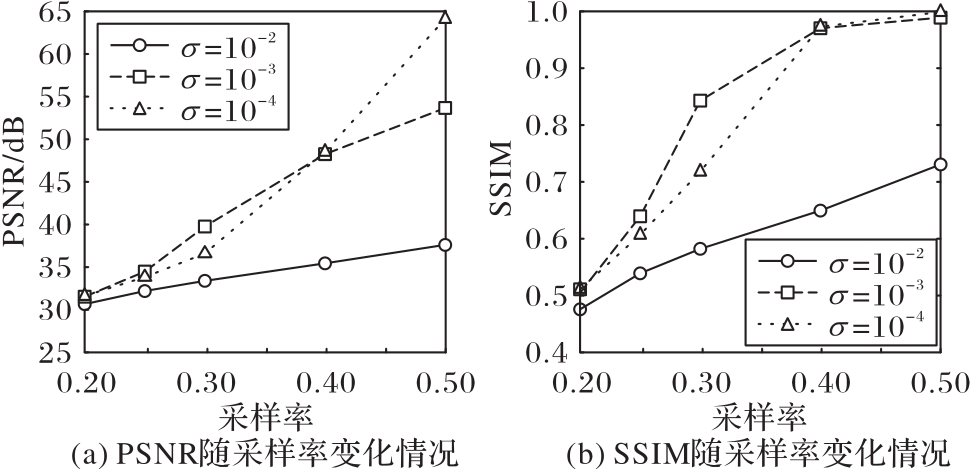
图2 仿真数据集图像上BU-MRI在不同噪声水平和采样率下的PSNR与SSIM
Fig. 2 PSNRs and SSIMs of BU-MRI on simulated image dataset at different noise levels and sampling rates
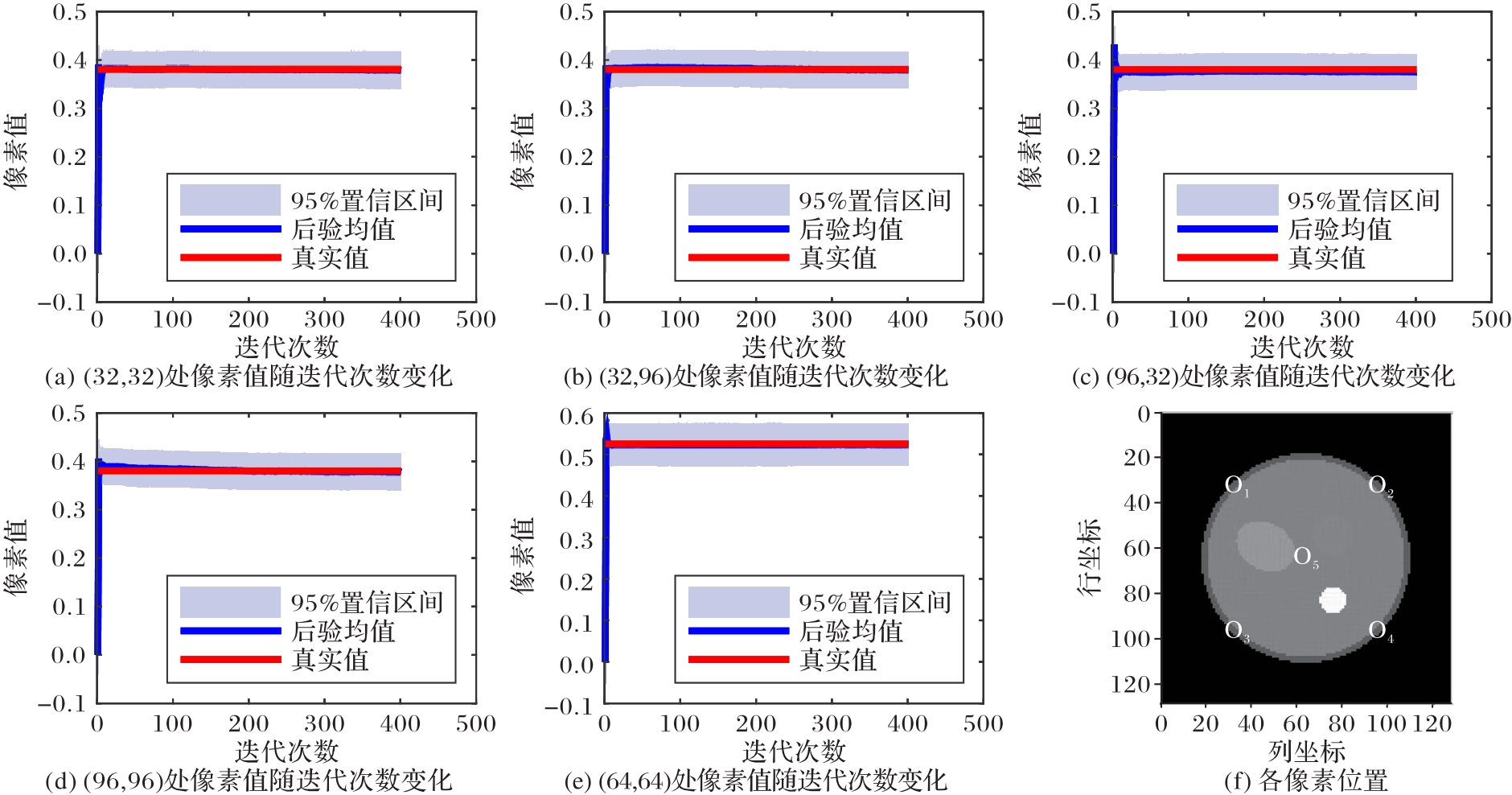
图3 仿真数据集图像上像素后验置信区间的BU-MRI重建不确定性量化
Fig. 3 Uncertainty quantification of BU-MRI reconstruction using pixel-wise posterior confidence intervals on simulated image datasets
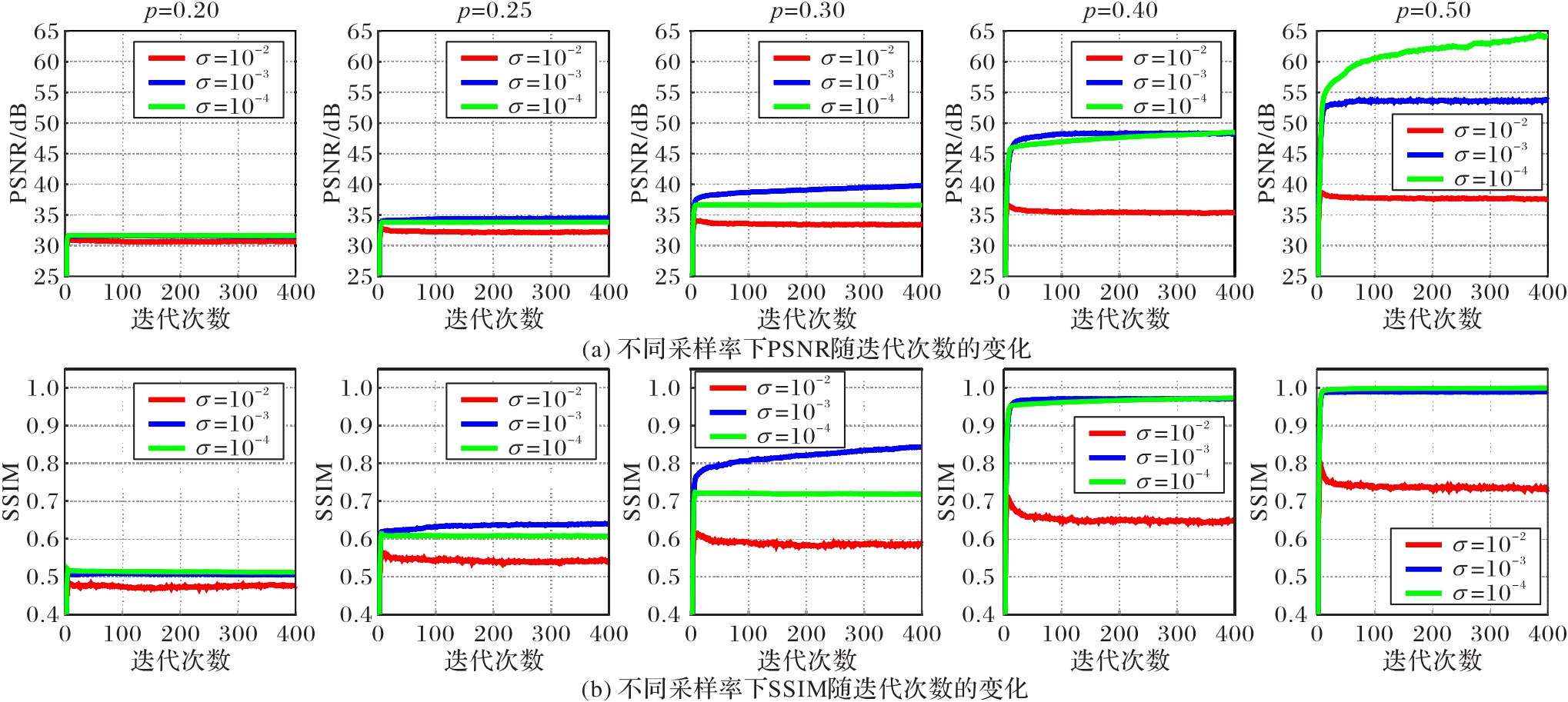
图4 仿真数据集图像上BU-MRI在不同采样率与噪声水平下PSNR和SSIM的迭代收敛曲线
Fig. 4 Iteration convergence curves of PSNR and SSIM for BU-MRI on simulated image dataset at different sampling rates and noise levels

图5 仿真数据集图像上不同方法的仿真图像重建对比
Fig. 5 Reconstruction comparison of simulated images by different methods on simulated image dataset
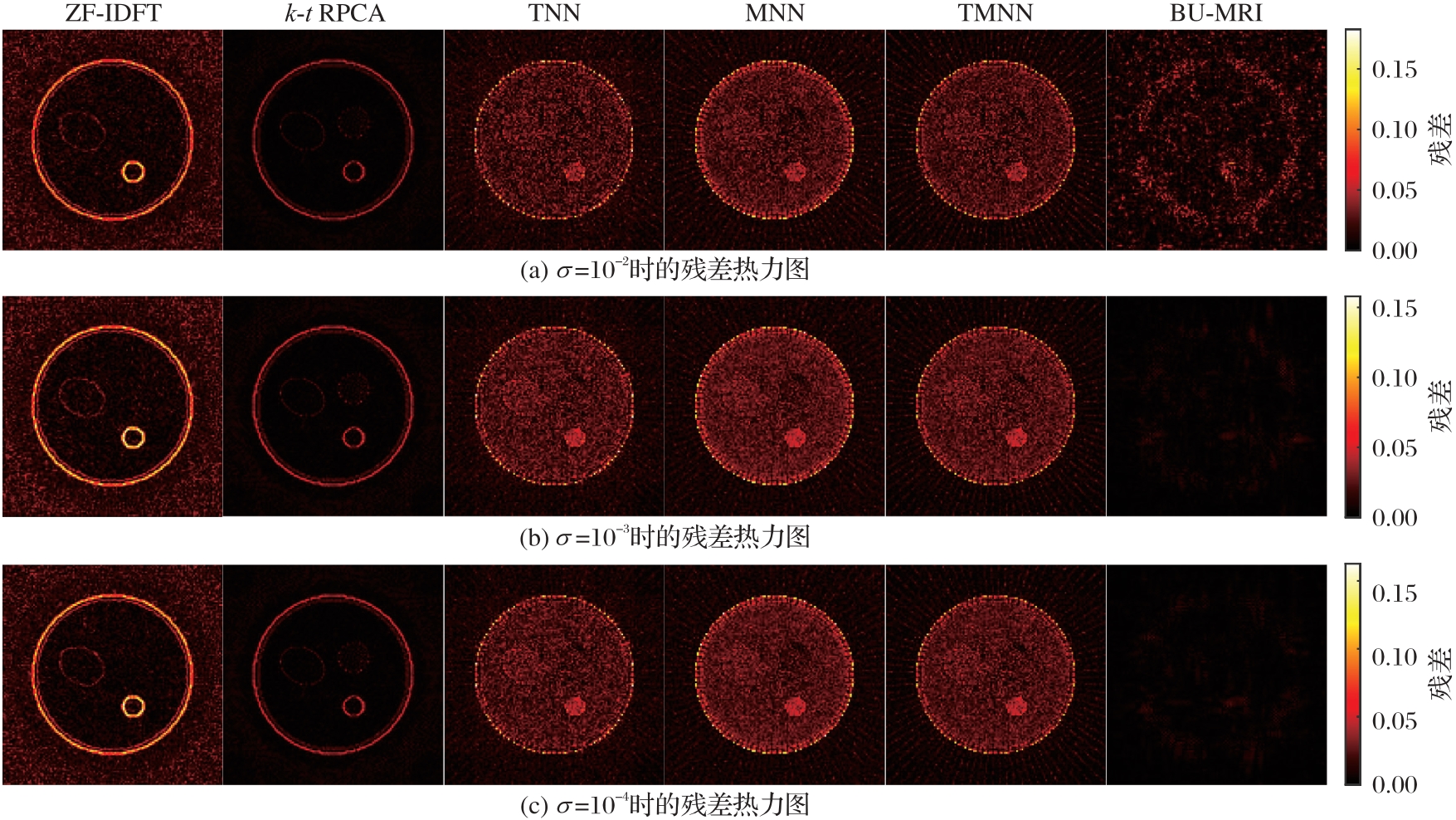
图6 仿真数据集图像上不同方法在多种噪声水平下的残差热力图对比
Fig. 6 Comparison of residual heatmaps obtained by different methods under multiple noise levels on simulated image dataset
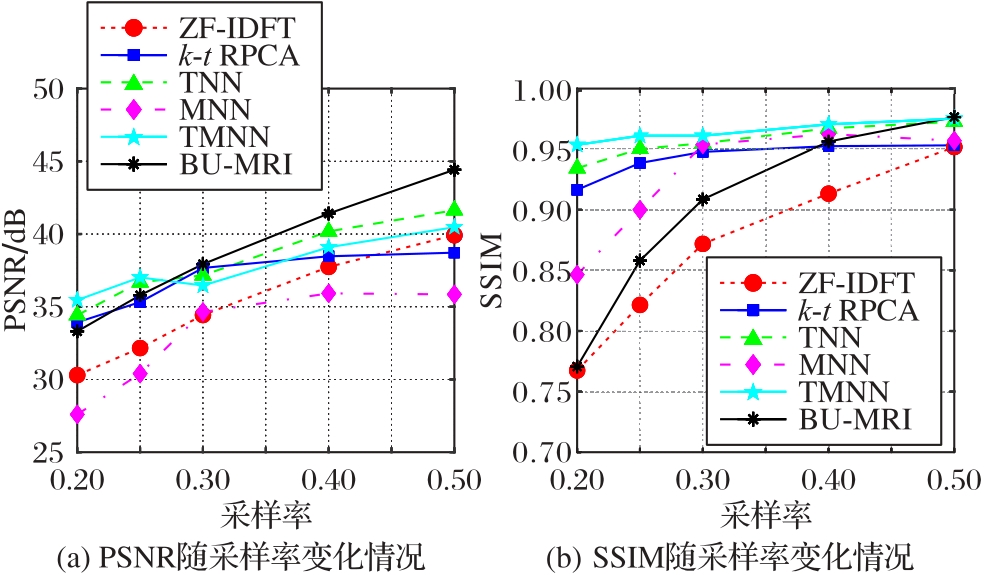
图7 BU-MRI在真实心脏MRI图像上的PSNR与SSIM随采样率变化
Fig. 7 PSNR and SSIM vs. sampling rate for BU-MRI method on real cardiac MRI images
| 方法 | p=0.20 | p=0.25 | p=0.30 | p=0.40 | p=0.50 | |||||
|---|---|---|---|---|---|---|---|---|---|---|
| PSNR/dB | SSIM | PSNR/dB | SSIM | PSNR/dB | SSIM | PSNR/dB | SSIM | PSNR/dB | SSIM | |
| ZF-IDFT | 30.30 | 0.767 4 | 32.16 | 0.821 5 | 34.43 | 0.871 9 | 37.74 | 0.913 3 | 39.92 | 0.951 8 |
| k-t RPCA | 33.93 | 0.916 5 | 35.32 | 0.938 6 | 37.67 | 0.947 8 | 38.47 | 0.952 5 | 38.72 | 0.953 2 |
| TNN | 34.42 | 0.934 3 | 36.68 | 0.950 2 | 37.16 | 0.954 9 | 40.18 | 0.967 2 | 41.64 | 0.972 7 |
| MNN | 27.60 | 0.846 5 | 30.40 | 0.900 0 | 34.64 | 0.953 8 | 35.92 | 0.962 5 | 35.85 | 0.957 0 |
| TMNN | 35.46 | 0.953 6 | 37.02 | 0.961 1 | 36.46 | 0.961 1 | 39.09 | 0.970 5 | 40.47 | 0.975 2 |
| BU-MRI | 33.31 | 0.770 6 | 35.79 | 0.858 1 | 37.93 | 0.908 6 | 41.41 | 0.956 3 | 44.42 | 0.976 5 |
表3 真实心脏MRI图像上不同方法的性能对比
Tab. 3 Performance comparison of different methods on real cardiac MRI images
| 方法 | p=0.20 | p=0.25 | p=0.30 | p=0.40 | p=0.50 | |||||
|---|---|---|---|---|---|---|---|---|---|---|
| PSNR/dB | SSIM | PSNR/dB | SSIM | PSNR/dB | SSIM | PSNR/dB | SSIM | PSNR/dB | SSIM | |
| ZF-IDFT | 30.30 | 0.767 4 | 32.16 | 0.821 5 | 34.43 | 0.871 9 | 37.74 | 0.913 3 | 39.92 | 0.951 8 |
| k-t RPCA | 33.93 | 0.916 5 | 35.32 | 0.938 6 | 37.67 | 0.947 8 | 38.47 | 0.952 5 | 38.72 | 0.953 2 |
| TNN | 34.42 | 0.934 3 | 36.68 | 0.950 2 | 37.16 | 0.954 9 | 40.18 | 0.967 2 | 41.64 | 0.972 7 |
| MNN | 27.60 | 0.846 5 | 30.40 | 0.900 0 | 34.64 | 0.953 8 | 35.92 | 0.962 5 | 35.85 | 0.957 0 |
| TMNN | 35.46 | 0.953 6 | 37.02 | 0.961 1 | 36.46 | 0.961 1 | 39.09 | 0.970 5 | 40.47 | 0.975 2 |
| BU-MRI | 33.31 | 0.770 6 | 35.79 | 0.858 1 | 37.93 | 0.908 6 | 41.41 | 0.956 3 | 44.42 | 0.976 5 |
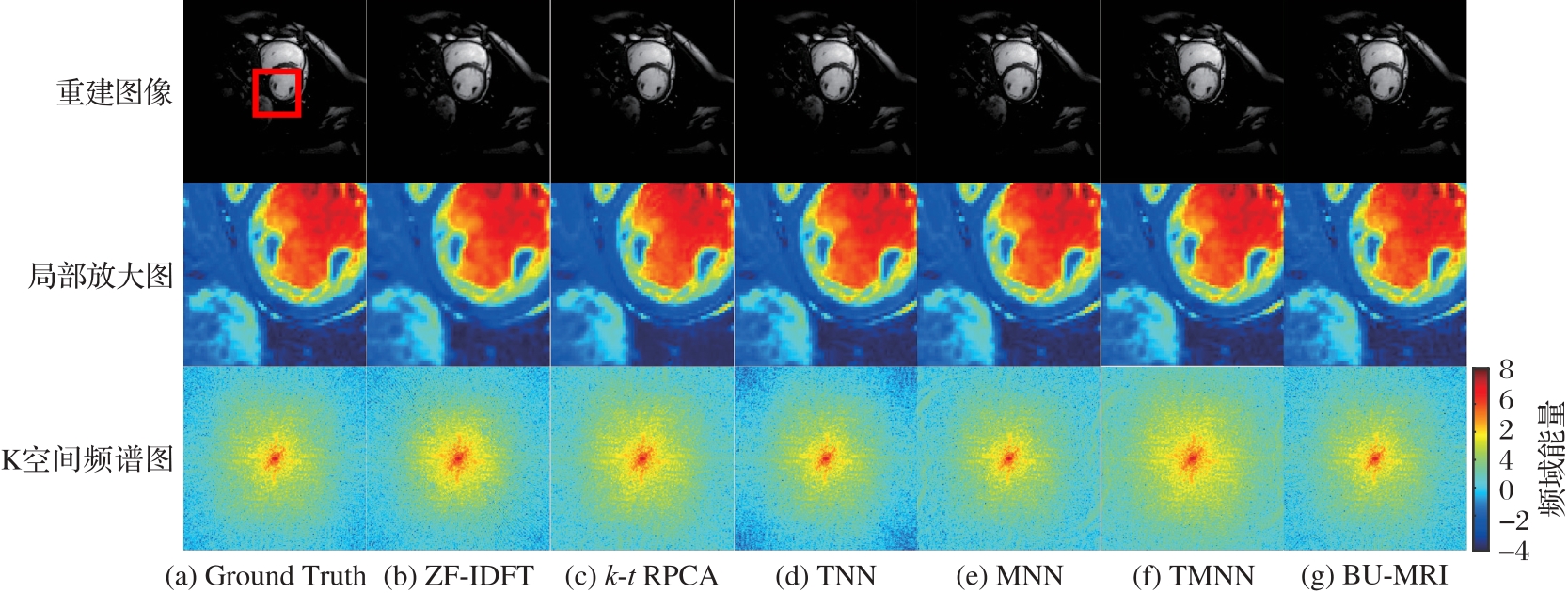
图8 不同方法对真实心脏MRI图像的重建对比
Fig. 8 Reconstruction comparison of real cardiac MRI images by different methods

图9 真实心脏MRI图像上不同方法在p=0.50时的残差热力图对比
Fig. 9 Comparison of residual heatmaps by different methods on real cardiac MRI images with p=0.50
| p | DIFF-MRI | BU-MRI | ||
|---|---|---|---|---|
| PSNR/dB | SSIM | PSNR/dB | SSIM | |
| 0.20 | 32.18 | 0.904 3 | 31.16 | 0.744 6 |
| 0.25 | 33.14 | 0.916 8 | 33.03 | 0.819 5 |
| 0.30 | 34.06 | 0.926 5 | 34.47 | 0.861 9 |
| 0.40 | 35.67 | 0.940 2 | 37.30 | 0.919 3 |
| 0.50 | 36.73 | 0.948 2 | 40.37 | 0.954 7 |
表4 不同欠采样比例下DIFF-MRI与BU-MRI的大脑MRI重建性能对比
Tab. 4 Comparison of brain MRI reconstruction performance between DIFF-MRI and BU-MRI at different undersampling rates
| p | DIFF-MRI | BU-MRI | ||
|---|---|---|---|---|
| PSNR/dB | SSIM | PSNR/dB | SSIM | |
| 0.20 | 32.18 | 0.904 3 | 31.16 | 0.744 6 |
| 0.25 | 33.14 | 0.916 8 | 33.03 | 0.819 5 |
| 0.30 | 34.06 | 0.926 5 | 34.47 | 0.861 9 |
| 0.40 | 35.67 | 0.940 2 | 37.30 | 0.919 3 |
| 0.50 | 36.73 | 0.948 2 | 40.37 | 0.954 7 |
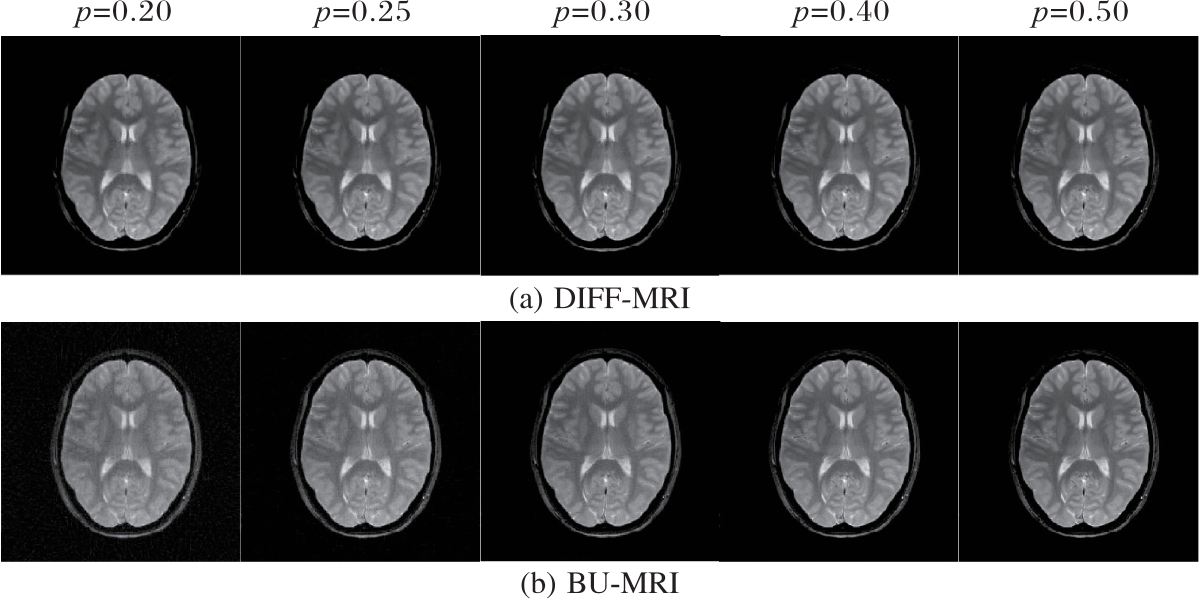
图10 不同欠采样比例下DIFF-MRI与BU-MRI的大脑MRI重建对比
Fig. 10 Comparison of brain MRI reconstruction between DIFF-MRI and BU-MRI at different undersampling rates
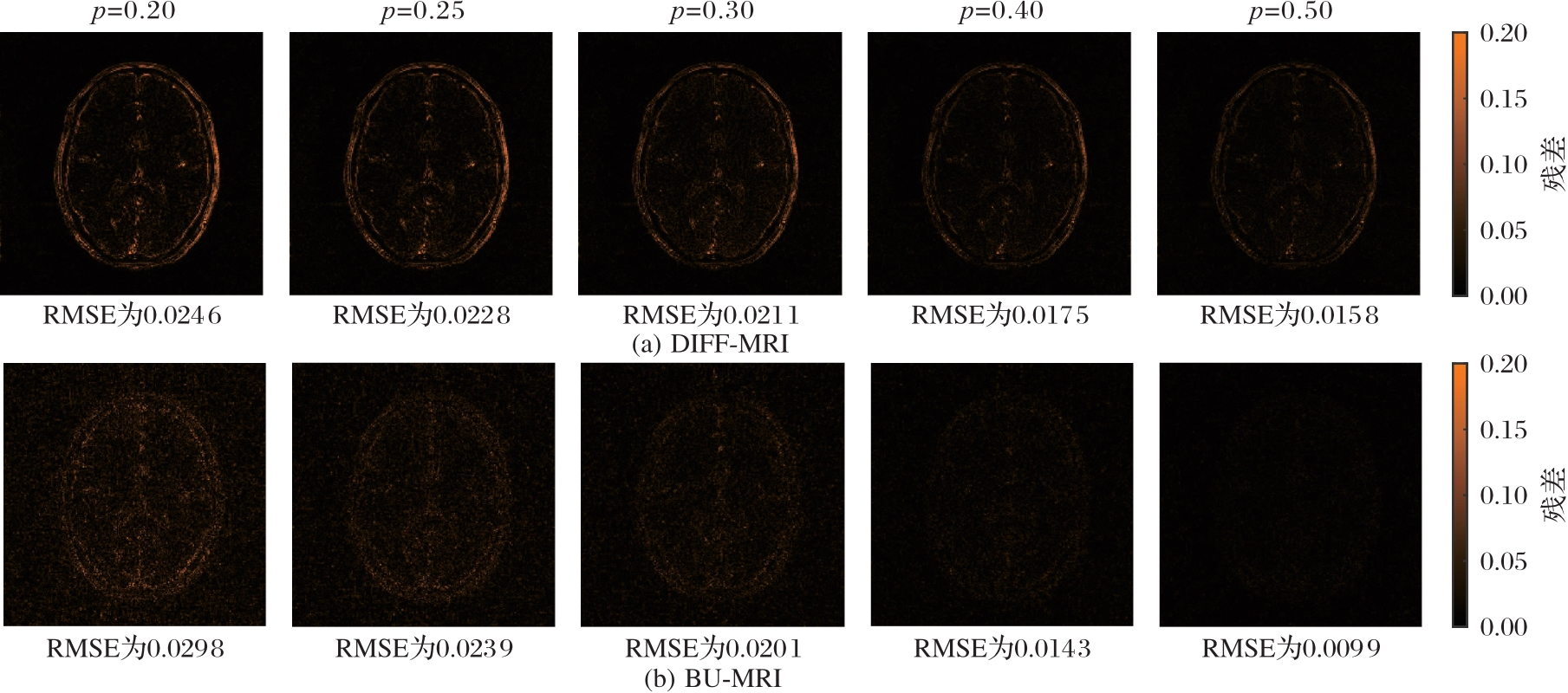
图11 不同欠采样比例下DIFF-MRI与BU-MRI的大脑MRI重建残差图对比
Fig. 11 Comparison of residual maps for brain MRI reconstruction between DIFF-MRI and BU-MRI at different undersampling rates
| PSNR/dB | SSIM | ||||
|---|---|---|---|---|---|
| 0 | 0 | 0 | 48.26 | 0.970 4 | |
| 0 | 0 | 48.14 | 0.970 1 | ||
| 0 | 0 | 0 | 45.17 | 0.940 6 | |
| 0 | 0 | 45.85 | 0.948 2 | ||
| 0 | 0 | 28.55 | 0.329 3 | ||
| 0 | 29.04 | 0.343 7 | |||
| 0 | 0 | 26.66 | 0.268 0 | ||
| 0 | 26.36 | 0.259 9 | |||
| 0 | 0 | 47.99 | 0.968 1 | ||
| 0 | 48.21 | 0.970 2 | |||
| 0 | 0 | 44.83 | 0.937 8 | ||
| 0 | 45.59 | 0.942 6 | |||
| 0 | 28.85 | 0.337 6 | |||
| 28.72 | 0.335 3 | ||||
| 0 | 26.59 | 0.269 7 | |||
| 26.28 | 0.261 9 |
表5 不同参数时的性能对比
Tab. 5 Performance comparison of different parameters
| PSNR/dB | SSIM | ||||
|---|---|---|---|---|---|
| 0 | 0 | 0 | 48.26 | 0.970 4 | |
| 0 | 0 | 48.14 | 0.970 1 | ||
| 0 | 0 | 0 | 45.17 | 0.940 6 | |
| 0 | 0 | 45.85 | 0.948 2 | ||
| 0 | 0 | 28.55 | 0.329 3 | ||
| 0 | 29.04 | 0.343 7 | |||
| 0 | 0 | 26.66 | 0.268 0 | ||
| 0 | 26.36 | 0.259 9 | |||
| 0 | 0 | 47.99 | 0.968 1 | ||
| 0 | 48.21 | 0.970 2 | |||
| 0 | 0 | 44.83 | 0.937 8 | ||
| 0 | 45.59 | 0.942 6 | |||
| 0 | 28.85 | 0.337 6 | |||
| 28.72 | 0.335 3 | ||||
| 0 | 26.59 | 0.269 7 | |||
| 26.28 | 0.261 9 |
| [1] | QUAN T M, JEONG W K. Compressed sensing reconstruction of dynamic contrast enhanced MRI using GPU-accelerated convolutional sparse coding[C]// Proceedings of the IEEE 13th International Symposium on Biomedical Imaging. Piscataway: IEEE, 2016: 518-521. |
| [2] | SALERNO M, SHARIF B, ARHEDEN H, et al. Recent advances in cardiovascular magnetic resonance techniques and applications[J]. Circulation: Cardiovascular Imaging, 2017, 10(6): No.e003951. |
| [3] | LUSTIG M, DONOHO D, PAULY J M. Sparse MRI: the application of compressed sensing for rapid MR imaging[J]. Magnetic Resonance in Medicine, 2007, 58(6): 1182-1195. |
| [4] | GAMPER U, BOESIGER P, KOZERKE S. Compressed sensing in dynamic MRI[J]. Magnetic Resonance in Medicine, 2008, 59(2): 365-373. |
| [5] | YE J C. Compressed sensing MRI: a review from signal processing perspective[J]. BMC Biomedical Engineering, 2019, 1: No.8. |
| [6] | LUSTIG M, SANTOS J M, DONOHO D L, et al. k-t SPARSE: high frame rate dynamic MRI exploiting spatio-temporal sparsity[EB/OL]. [2025-08-26].. |
| [7] | TANNER J, VARY S. Compressed sensing of low-rank plus sparse matrices[J]. Applied and Computational Harmonic Analysis, 2023, 64: 254-293. |
| [8] | FENG L, BENKERT T, BLOCK K T, et al. Compressed sensing for body MRI[J]. Journal of Magnetic Resonance Imaging, 2017, 45(4): 966-987. |
| [9] | SANDILYA M, NIRMALA S R. Compressed sensing trends in magnetic resonance imaging[J]. Engineering Science and Technology, an International Journal, 2017, 20(4): 1342-1352. |
| [10] | LIU Y, CAI J F, ZHAN Z, et al. Balanced sparse model for tight frames in compressed sensing magnetic resonance imaging[J]. PLoS ONE, 2015, 10(4): No.e0119584. |
| [11] | STÉPHANE M. A wavelet tour of signal processing: the sparse way[M]. New York: Academic Press, 2009. |
| [12] | GU H, YAMAN B, MOELLER S, et al. Revisiting ℓ1-wavelet compressed-sensing MRI in the era of deep learning[J]. Proceedings of the National Academy of Sciences of the United States of America, 2022, 119(33): No.e2201062119. |
| [13] | LAI Z, QU X, LIU Y, et al. Image reconstruction of compressed sensing MRI using graph-based redundant wavelet transform[J]. Medical Image Analysis, 2016, 27: 93-104. |
| [14] | MacKAY D J C. Bayesian interpolation[J]. Neural Computation, 1992, 4(3): 415-447. |
| [15] | TIPPING M E. Sparse Bayesian learning and the relevance vector machine[J]. Journal of Machine Learning Research, 2001, 1: 211-244. |
| [16] | WIPF D P, RAO B D. Sparse Bayesian learning for basis selection[J]. IEEE Transactions on Signal Processing, 2004, 52(8): 2153-2164. |
| [17] | TAN X, LI J. Computationally efficient sparse Bayesian learning via belief propagation[J]. IEEE Transactions on Signal Processing, 2010, 58(4): 2010-2021. |
| [18] | WAN J, ZHANG Z, YAN J, et al. Sparse Bayesian multi-task learning for predicting cognitive outcomes from neuroimaging measures in Alzheimer's disease[C]// Proceedings of the 2012 IEEE Conference on Computer Vision and Pattern Recognition. Piscataway: IEEE, 2012: 940-947. |
| [19] | BABACAN S D, MOLINA R, KATSAGGELOS A K. Bayesian compressive sensing using Laplace priors[J]. IEEE Transactions on Image Processing, 2010, 19(1): 53-63. |
| [20] | DONOHO D L. Compressed sensing[J]. IEEE Transactions on Information Theory, 2006, 52(4): 1289-1306. |
| [21] | LUSTIG M, DONOHO D L, SANTOS J M, et al. Compressed sensing MRI[J]. IEEE Signal Processing Magazine, 2008, 25(2): 72-82. |
| [22] | 沈马锐,李金城,张亚,等.基于非凸全变差正则的核磁共振图像重构算法[J].计算机应用,2020,40(8):2358-2364. |
| SHEN M R, LI J C, ZHANG Y, et al. Magnetic resonance image reconstruction algorithm via non-convex total variation regularization[J]. Journal of Computer Applications, 2020, 40(8): 2358-2364. | |
| [23] | JUNG H, SUNG K, NAYAK K S, et al. k-t FOCUSS: a general compressed sensing framework for high resolution dynamic MRI[J]. Magnetic Resonance in Medicine, 2009, 61(1): 103-116. |
| [24] | JUNG H, YE J C, KIM E Y. Improved k-t BLAST and k-t SENSE using FOCUSS[J]. Physics in Medicine and Biology, 2007, 52(11): 3201-3226. |
| [25] | TRÉMOULHÉAC B, DIKAIOS N, ATKINSON D, et al. Dynamic MR image reconstruction-separation from undersampled (k,t)‑space via low-rank plus sparse prior[J]. IEEE Transactions on Medical Imaging, 2014, 33(8): 1689-1701. |
| [26] | LU C, FENG J, CHEN Y, et al. Tensor robust principal component analysis with a new tensor nuclear norm[J]. IEEE Transactions on Pattern Analysis and Machine Intelligence, 2020, 42(4): 925-938. |
| [27] | ZHANG Y, HU Y. Dynamic cardiac MRI reconstruction using combined tensor nuclear norm and Casorati matrix nuclear norm regularizations[C]// Proceedings of the IEEE 19th International Symposium on Biomedical Imaging. Piscataway: IEEE, 2022: 1-4. |
| [28] | HECKEL R, JACOB M, CHAUDHARI A, et al. Deep learning for accelerated and robust MRI reconstruction[J]. Magnetic Resonance Materials in Physics, Biology and Medicine, 2024, 37(3): 335-368. |
| [29] | ZBONTAR J, KNOLL F, SRIRAM A, et al. fastMRI: an open dataset and benchmarks for accelerated MRI[EB/OL]. [2025-09-16].. |
| [30] | BIAN W, TAMILSELVAM Y K. A review of optimization-based deep learning models for MRI reconstruction[J]. AppliedMath, 2024, 4(3): 1098-1127. |
| [31] | YAMAN B, HOSSEINI S A H, MOELLER S, et al. Self-supervised learning of physics-guided reconstruction neural networks without fully sampled reference data[J]. Magnetic Resonance in Medicine, 2020, 84(6): 3172-3191. |
| [32] | KORKMAZ Y, CUKUR T, PATEL V M. Self-supervised MRI reconstruction with unrolled diffusion models[C]// Proceedings of the 2023 International Conference on Medical Image Computing and Computer-Assisted Intervention, LNCS 14229. Cham: Springer, 2023: 491-501. |
| [33] | LI X, ZHANG H, YANG H, et al. CS-MRI reconstruction using an improved GAN with dilated residual networks and channel attention mechanism[J]. Sensors, 2023, 23(18): No.7685. |
| [34] | 邱华禄,蔺素珍,王彦博,等.基于复卷积双域级联网络的欠采样磁共振图像重建算法[J].计算机应用,2024,44(2):580-587. |
| QIU H L, LIN S Z, WANG Y B,et al. Reconstruction algorithm for undersampled magnetic resonance images based on complex convolution dual-domain cascade network[J]. Journal of Computer Applications, 2024, 44(2): 580-587. | |
| [35] | WEBBER G, READER A J. Diffusion models for medical image reconstruction[J]. BJR|Artificial Intelligence, 2024, 1(1): No.ubae013. |
| [36] | LIU X, HE J, MI C, et al. Low-rank plus sparse joint smoothing model based on tensor singular value decomposition for dynamic MRI reconstruction[J]. Magnetic Resonance Imaging, 2023, 104: 52-60. |
| [37] | GONG M, ZHANG G. Non-local tensor sparse representation and tensor low rank regularization for dynamic MRI reconstruction[J]. International Journal of Machine Learning and Cybernetics, 2024, 15(2): 493-503. |
| [38] | DEORA P, VASUDEVA B, BHATTACHARYA S, et al. Structure preserving compressive sensing MRI reconstruction using generative adversarial networks[C]// Proceedings of the 2020 IEEE/CVF Conference on Computer Vision and Pattern Recognition Workshops. Piscataway: IEEE, 2020: 2211-2219. |
| [39] | CAO J, LIU S, LIU H, et al. MRI reconstruction based on Bayesian group sparse representation[J]. Signal Processing, 2021, 187: No.108151. |
| [40] | LUO G, BLUMENTHAL M, HEIDE M, et al. Bayesian MRI reconstruction with joint uncertainty estimation using diffusion models[J]. Magnetic Resonance in Medicine, 2023, 90(1): 295-311. |
| [1] | 杨俊, 庞梦雪, 乔立山. 融合时序相关信息的脑功能网络估计与分类[J]. 《计算机应用》唯一官方网站, 2025, 45(5): 1403-1409. |
| [2] | 刘宇, 张鹏程, 张丽媛, 刘祎, 桂志国, 张雪怡, 朱陈一菲, 汤豪威. 基于低秩与全变分联合正则化的低剂量CT图像重建[J]. 《计算机应用》唯一官方网站, 2025, 45(3): 978-987. |
| [3] | 肖海林, 孔祥婷, 王玉, 周迪, 戴晓明. 基于改进奇异值分解和哈尔小波变换的图像水印算法[J]. 《计算机应用》唯一官方网站, 2025, 45(3): 896-903. |
| [4] | 薛雅丽, 徐忠敏, 刘世豪. 基于多级小波残差网络的重力数据去噪方法[J]. 《计算机应用》唯一官方网站, 2025, 45(10): 3336-3341. |
| [5] | 黄颖, 李昌盛, 彭慧, 刘苏. 用于动态场景高动态范围成像的局部熵引导的双分支网络[J]. 《计算机应用》唯一官方网站, 2025, 45(1): 204-213. |
| [6] | 李牧, 骆宇, 柯熙政. 基于调频连续波雷达的人体生命体征检测算法[J]. 《计算机应用》唯一官方网站, 2024, 44(6): 1978-1986. |
| [7] | 周景贤, 李希娜. 基于改进卷积神经网络和射频指纹的无人机检测与识别[J]. 《计算机应用》唯一官方网站, 2024, 44(3): 876-882. |
| [8] | 邱华禄, 蔺素珍, 王彦博, 刘峰, 李大威. 基于复卷积双域级联网络的欠采样磁共振图像重建算法[J]. 《计算机应用》唯一官方网站, 2024, 44(2): 580-587. |
| [9] | 沈嫣然, 温昕, 张瑾昊, 张帅, 曹锐, 高保禄. 轻量级多尺度卷积网络的功能磁共振成像脑龄预测模型[J]. 《计算机应用》唯一官方网站, 2024, 44(12): 3949-3957. |
| [10] | 叶力硕, 何志学. 融合小波分解的多尺度时间序列异常检测[J]. 《计算机应用》唯一官方网站, 2024, 44(10): 3300-3306. |
| [11] | 刘阳, 陆志扬, 王骏, 施俊. 基于自注意力连接UNet的磁共振成像去吉布斯伪影算法[J]. 《计算机应用》唯一官方网站, 2023, 43(5): 1606-1611. |
| [12] | 王昊, 王子成, 张超, 马韵升. 基于生成对抗网络的数据不确定性量化方法[J]. 《计算机应用》唯一官方网站, 2023, 43(4): 1094-1101. |
| [13] | 樊小宇, 蔺素珍, 王彦博, 刘峰, 李大威. 基于残差图卷积神经网络的高倍欠采样核磁共振图像重建算法[J]. 《计算机应用》唯一官方网站, 2023, 43(4): 1261-1268. |
| [14] | 何国欢, 朱江平. WT-U-Net++:基于小波变换的表面缺陷检测网络[J]. 《计算机应用》唯一官方网站, 2023, 43(10): 3260-3266. |
| [15] | 廖光锴, 张正, 宋治国. 基于小波特征与注意力机制结合的卷积网络车辆重识别[J]. 《计算机应用》唯一官方网站, 2022, 42(6): 1876-1883. |
| 阅读次数 | ||||||
|
全文 |
|
|||||
|
摘要 |
|
|||||
